
Yes, Los Angeles operates court-supervised drug court programs for eligible nonviolent defendants. Successful completion typically leads to treatment-based outcomes, including possible charge reduction or dismissal, in place of jail time. The county runs several distinct tracks, including Adult Drug Court (ADC), Sentenced Offender Drug Court (SODC), and Co-Occurring Disorders Court (CODC), each with different intake rules and timelines.
TL;DR:
- Eligibility is limited to nonviolent cases, with some tracks restricting age, residency, and mental health conditions, which can affect program access.
- Most drug court programs last 6 to 9 months, with SODC involving a 90 to 104 day in-custody phase before outpatient treatment begins.
- Participants are continuously monitored through frequent drug testing, court check-ins, and graduated sanctions for violations, with rewards for compliance.
- Clinical services, including counseling, detox, medication-assisted treatment, and community support, are integral to the program’s success.
- Early legal intervention can influence program placement and outcome, especially before arraignment or plea negotiations, making attorney involvement crucial.
Table of Contents
- What Is Drug Court in Los Angeles?
- Who Qualifies for Drug Court in Los Angeles?
- The Main Types of Drug Court in Los Angeles
- How the Process Works: Intake, Phases, and Timelines
- Treatment Services and Community Support Available Through the Program
- What Happens If You Complete or Fail the Program
- How to Get Referred and When to Bring in a Lawyer
- Family and Community Support Inside the Program
- How Drug Court Differs From a Traditional Criminal Case
- Life After Graduation: What Long-Term Support Looks Like
- When and Why Participants Get Removed From the Program
- The Honest Take on Los Angeles Drug Court
- Sources
What Is Drug Court in Los Angeles?
Drug court replaces a straight sentence with court-supervised treatment. Instead of a judge handing down time and moving to the next case, a judge stays involved for months, checking in on the same person's progress toward sobriety and stability. Los Angeles built this model around a team, not a solo decision-maker.
That team usually includes a judge, a deputy district attorney, a public defender, a probation officer, and licensed treatment providers, all working from the same case file. This structure mirrors California's broader collaborative justice court framework, which treats addiction as a driver of criminal behavior rather than a separate problem to ignore. National research backs the approach: the National Institute of Justice has found that drug courts, when run with fidelity to the model, reduce recidivism and increase treatment engagement compared to conventional case processing.
A few things distinguish this setup from a normal criminal docket:
- The same judge sees the participant repeatedly, not just at arraignment and sentencing.
- Treatment compliance, not just legal compliance, determines the case outcome.
- The DA and public defender coordinate on case strategy instead of purely opposing each other.
Who Qualifies for Drug Court in Los Angeles?
Eligibility starts with one hard line: the underlying offense has to be nonviolent. A drug possession or low-level drug charge tends to qualify; a case involving violence, weapons, or certain sex offenses generally does not, regardless of any substance use history attached to it. Outstanding warrants, active parole status, and certain prior convictions can also disqualify a candidate before screening even begins.
Here's how the screening process usually unfolds:
- Referral and initial flag. A defense attorney, the public defender's office, or the court itself identifies a case as a potential fit, often at arraignment or shortly after.
- Pretrial Services (PTS) interview. A PTS officer interviews the defendant and reviews criminal history, residency, and case specifics to confirm baseline eligibility.
- Clinical assessment. A treatment provider or county clinician evaluates the severity of the substance use disorder and flags any co-occurring mental health condition.
- Program match. Based on the offense, custody status, and clinical findings, the case gets routed to a specific track, ADC, SODC, or CODC.
Program-specific rules add another layer. Co-Occurring Disorders Court restricts participants to ages 26 through 59 and requires residency in a qualifying Department of Mental Health service area. Juvenile drug court operates under its own family-centered rules entirely separate from the adult tracks.
The Main Types of Drug Court in Los Angeles
Not every drug case in LA lands in the same program, and the differences matter for what a defendant should expect day to day.
- Adult Drug Court (ADC). The standard track for nonviolent adult defendants. Participants remain out of custody while attending counseling, submitting to regular drug testing, and appearing before the judge on a set schedule. Most ADC participants access individual counseling, group sessions, and sometimes vocational or educational programming through Los Angeles County Probation.
- Sentenced Offender Drug Court (SODC). A post-conviction program that starts differently: participants begin in an in-custody treatment pod for roughly 90 to 104 days before moving to residential or sober-living placement and then outpatient care. The Los Angeles County Public Defender's office notes that completion can result in charge reduction or dismissal, but the path there runs longer than a typical ADC case.
- Co-Occurring Disorders Court (CODC). Built for defendants managing both a mental health condition and a substance use disorder. Because treatment for co-occurring conditions requires more coordination, CODC has narrower eligibility, tighter age brackets, and service-area limits tied to county mental health resources.
- Juvenile drug court. A voluntary, family-involved alternative for minors, emphasizing family therapy and school stability alongside substance use treatment rather than punitive supervision.
How the Process Works: Intake, Phases, and Timelines
Once a case gets routed into a program, the clock starts almost immediately. Intake assessments typically happen within days of the referral, not weeks, since courts want participants into treatment before momentum toward the old routine returns.
Most ADC tracks follow three general phases:
- Stabilization. Intensive treatment contact, frequent drug testing, and weekly or biweekly court check-ins while the participant adjusts to sobriety.
- Skill building. Reduced testing frequency, continued group counseling, and the start of vocational or educational components.
- Aftercare and transition. Lighter supervision as the participant demonstrates sustained compliance, moving toward graduation.
A note on timelines: Most ADC tracks run 6 to 9 months total, while SODC starts with a fixed 90 to 104 day in-custody phase before residential and outpatient care begin, meaning SODC participants often face a longer overall supervision period than someone in a standard adult track.
Monitoring never lets up during any phase. Judges review drug test results, treatment attendance, and probation reports at every court date. A missed test or a skipped session usually triggers a graduated sanction, extra community service or a curfew, rather than immediate termination. Consistent progress can earn rewards like reduced check-in frequency. The Government Accountability Office has pointed to this kind of steady, judge-led monitoring as one of the most reliable predictors of program fidelity and, by extension, better outcomes.
Treatment Services and Community Support Available Through the Program
Drug court in Los Angeles isn't just supervision with extra paperwork. It comes bundled with real clinical services, and the specific mix depends on the assessment results and the track a participant lands in.
Core clinical offerings typically include:
- Individual and group counseling sessions, often multiple times per week during early phases.
- Detox services for participants who need medical stabilization before outpatient treatment can start.
- Referrals for medication-assisted treatment (MAT) where clinically appropriate.
- Trauma-informed care for participants with co-occurring mental health conditions, coordinated closely with CODC clinical staff.
Beyond clinical treatment, several programs connect participants to vocational training, housing referrals, and sober living arrangements, and some ADC tracks even include acupuncture and other complementary supports alongside standard counseling. None of this happens in isolation. The LA County Department of Public Health's Substance Abuse Prevention and Control division runs on a no-wrong-door policy, meaning a person can enter treatment through nearly any county touchpoint, jail, court referral, or a community clinic, and still get connected to the same coordinated care system.
Pro Tip: Bring documentation of any prior treatment history to your clinical assessment. A record of past counseling, detox, or medication-assisted treatment helps the evaluator match you to the right level of care faster, instead of starting the assessment from zero.
What Happens If You Complete or Fail the Program
Graduating drug court usually means one of a few outcomes: the original charge gets reduced, the case gets dismissed outright, or the participant becomes eligible to petition for record relief down the line. SODC graduates should expect that completion doesn't necessarily end court involvement entirely. Because SODC follows a felony conviction, some participants remain on probation for a period afterward, so treatment success and full legal closure aren't always the same moment.
Falling short of program requirements doesn't automatically mean the end of the road, but it does trigger a structured response:
- First violations usually bring graduated sanctions like community service, curfews, or increased testing frequency.
- Repeated or serious violations can lead to short jail stays as an intermediate consequence.
- Continued noncompliance can result in termination from the program, which sends the case back to traditional sentencing on the original charge.
At that point, the legal options narrow considerably, and having an attorney who understands how the judge weighs prior compliance history against the violation becomes critical to whatever comes next.
How to Get Referred and When to Bring in a Lawyer
Getting into drug court rarely happens automatically. Someone, usually a defense attorney, has to raise it as an option and push the case toward screening before arraignment moves too far along. Preparing ahead of the Pretrial Services interview matters: bring proof of residency, any prior treatment records, and a clear account of the current charge's circumstances.
Legal counsel changes outcomes at several points in this process, not just at sentencing. An attorney can:
- Argue for eligibility when a borderline criminal history or an ambiguous charge classification puts program access in doubt.
- Push back on a clinical assessment that seems to undercount the severity of a substance use disorder or misses a co-occurring condition.
- Negotiate entry terms, including which track a case gets routed to, before the assignment becomes final.
Experienced criminal defense attorneys have represented clients through Los Angeles diversion programs and mental health court proceedings, working directly with the judges, prosecutors, and public defenders who staff these treatment courts. That familiarity with local courtroom dynamics often shapes whether a marginal case gets a fair shot at treatment instead of a straight conviction.
For readers starting this process, Los Angeles County Probation's drug court intake information and the public defender's treatment courts division are the two most direct county contact points. A drug crimes defense attorney can help determine which of these routes fits a specific charge before the window to apply closes.
Family and Community Support Inside the Program
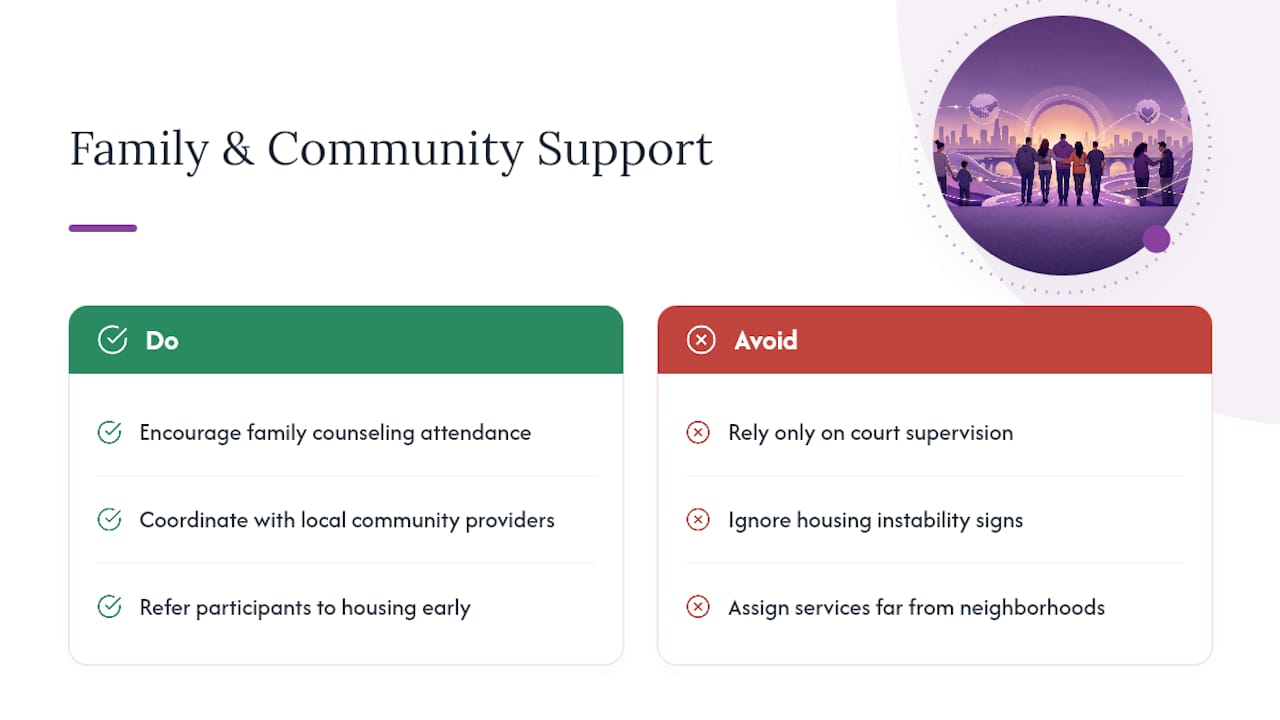
Nobody gets through a nine-month treatment schedule on court supervision alone, and Los Angeles drug courts build that reality into how they run. Family involvement isn't formally required in every adult track the way it is in juvenile drug court, but treatment providers routinely encourage family participation in counseling sessions, especially during the stabilization phase when relapse risk runs highest.
Community-based organizations fill in a lot of the space between court dates. Sober living homes, faith-based recovery groups, and county-contracted outpatient clinics often become the daily support structure a participant relies on between scheduled check-ins. Because SAPC coordinates with a wide network of community providers rather than a single centralized clinic, participants frequently end up in a program close to their own neighborhood, which makes consistent attendance more realistic than a long commute would allow.
Family also plays a practical role in stability during the program. A participant with steady housing and someone checking in daily has a very different day-to-day experience than someone facing the same treatment schedule without that support. Judges and probation officers notice this too. A participant's living situation and support network often come up directly in progress reports, since housing instability is one of the more common reasons someone starts missing sessions or testing positive again. Programs that connect participants to housing referrals early tend to see fewer of these disruptions later in the timeline.
How Drug Court Differs From a Traditional Criminal Case
A standard criminal case in Los Angeles moves in a straight line: arraignment, pretrial hearings, a plea or trial, then sentencing. The judge who hears the case at arraignment may never see the defendant again after sentencing. Drug court breaks that pattern entirely.
The most obvious difference is the judge's role. In traditional court, the judge is a neutral arbiter deciding guilt and punishment. In drug court, the same judge stays on the case for months, reviewing progress reports and talking directly to the participant at every hearing, sometimes weekly. That ongoing relationship doesn't exist in conventional sentencing.
The second major difference is what determines the outcome. A traditional case ends once a sentence is handed down; the legal question is closed. A drug court case stays open until treatment goals are met, and the final result, dismissal, reduction, or continued probation, depends on clinical progress rather than a single court date's ruling. The DA and public defender also work differently here. Instead of arguing opposite positions on guilt, both sides often collaborate on how to keep a participant in treatment and moving forward, reserving disagreement for how to handle specific violations rather than the underlying case itself.
For a defendant, this means drug court trades a faster, more predictable process for one that's longer but offers a genuine chance to avoid a permanent conviction. Traditional court resolves quickly; drug court asks for patience in exchange for a better long-term result.
Life After Graduation: What Long-Term Support Looks Like
Graduating from drug court doesn't mean county support disappears the day the case closes. Many participants transition into aftercare arrangements that carry forward the same providers and case managers they worked with during active treatment. This helps prevent the kind of abrupt drop-off that often triggers relapse in early recovery.
Ongoing outpatient counseling remains available to graduates who want to continue, and SAPC's broader treatment network doesn't require a court order to stay engaged with services. Sober living arrangements that started as a program requirement frequently continue as a voluntary living situation after graduation, since many participants find the structure useful well beyond the court's supervision period.
Vocational and educational connections made during the program tend to have the longest-lasting impact. A participant who completed job training or started a certification program during treatment usually keeps that momentum going afterward, and employment stability is one of the strongest buffers against relapse the county's treatment partners consistently point to.
For SODC graduates specifically, continued probation supervision after treatment completion means a probation officer stays involved even after the clinical program ends. That overlap gives graduates a built-in check-in structure during the highest-risk period after intensive treatment stops, rather than a hard cutoff from all supervision the moment the program wraps up.
When and Why Participants Get Removed From the Program
Termination is the outcome every drug court tries to avoid, but it happens when noncompliance becomes a pattern rather than an isolated slip. Courts generally distinguish between a single missed test, which usually draws a sanction, and repeated failures to show up, ongoing positive tests despite escalating consequences, or a new arrest during the program, which move a case toward termination review.
New criminal conduct while enrolled is treated especially seriously. A fresh arrest, even for something unrelated to the original drug charge, typically triggers an immediate review of program status and often results in removal regardless of how much progress the participant had made previously.
Once termination happens, the case returns to traditional criminal court for sentencing on the original charge, and the treatment-based outcomes that were on the table, dismissal or reduction, are generally no longer available. This is exactly where legal representation makes the most difference: an attorney can sometimes negotiate a second chance before termination becomes final, particularly if a violation stemmed from a documented relapse rather than outright noncompliance, or if program staff didn't follow proper notice procedures before recommending removal.
The Honest Take on Los Angeles Drug Court
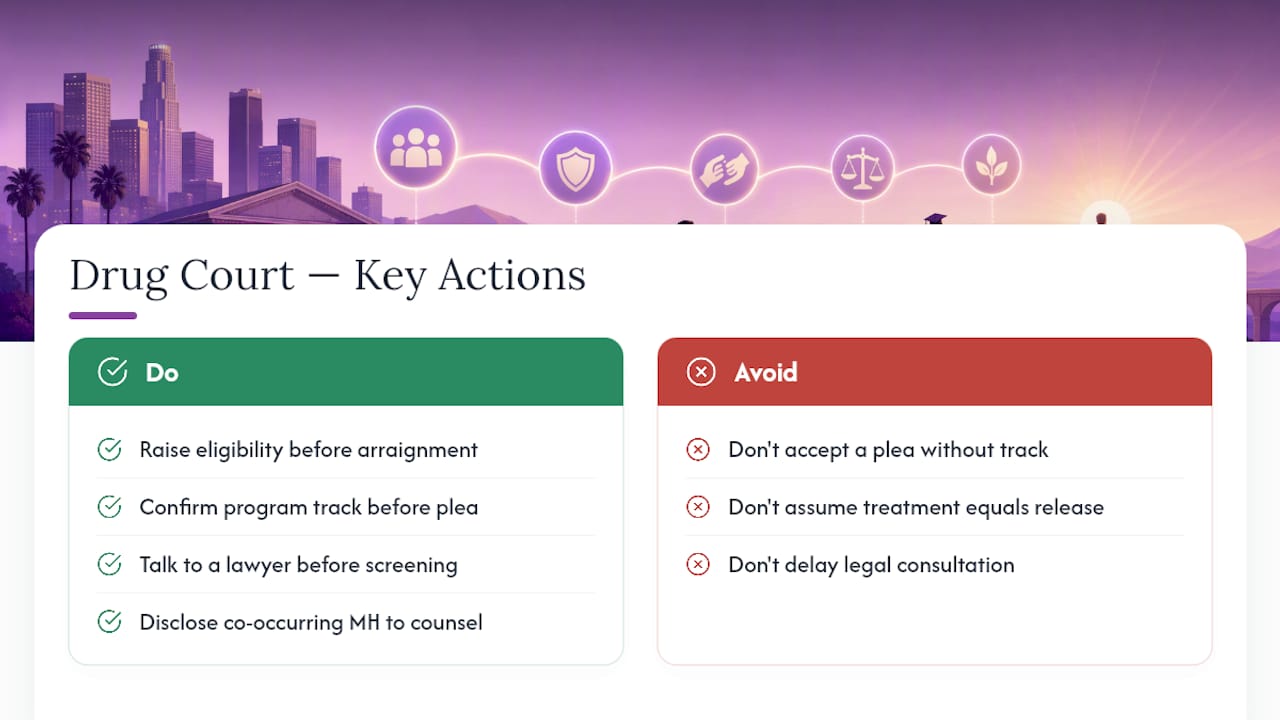
The biggest thing people misunderstand about Los Angeles drug court is timing. Most guidance treats it like a program you request after you've already been charged and processed through the usual channels. In practice, the earlier a defense attorney raises drug court eligibility, ideally before arraignment moves forward, the more leverage exists to shape which track a case lands in and how the clinical assessment gets framed.
Conventional advice also underplays how different SODC is from a standard ADC case. Telling someone "you'll get treatment instead of jail" without mentioning the 90 to 104 day in-custody phase sets up a bad surprise. That gap between what people expect and what SODC actually requires causes more frustration than the treatment itself.
If there's one priority for anyone reading this while facing a pending drug charge, it's this: get a clear answer on which specific program track your case is likely to be routed to before you accept any plea framing. ADC, SODC, and CODC are not interchangeable, and the difference changes your entire timeline.
— Jake
Anyone weighing drug court against a standard plea should talk to a lawyer before the screening window closes, since program assignment often gets locked in faster than people expect. Rubin Law, P.C. represents Los Angeles defendants through the diversion and treatment court process, including cases involving co-occurring mental health conditions handled under the firm's mental health defense practice, and works directly with the public defender's office and county probation to push for the strongest possible entry terms. If you're facing a drug charge and want to know whether treatment court is realistically on the table for your case, reach out to discuss your drug charge defense options before your next court date.
This article is general information, not a substitute for advice from a qualified lawyer. Consult a qualified legal professional about your own circumstances before acting on anything here.
Sources
- Drug Court Program - Los Angeles County Probation
- LA County Department of Public Health - SAPC criminal justice programs
- Drug Courts | Judicial Branch of California