Refusing a breath test after a lawful DUI arrest in California triggers an automatic administrative license suspension under California Vehicle Code §23612 and hands prosecutors a piece of evidence they will use against you in criminal court. The single most important thing you can do right now: request a DMV hearing within 10 days of your arrest. Miss that window, and your license is suspended automatically with no administrative recourse.
Here is what happens the moment you refuse:
- Administrative suspension: Your driving privilege is suspended for one year on a first refusal, with no restricted license available during that period.
- Extended revocation with priors: If you have a prior DUI conviction or refusal within the past 10 years, the revocation extends to two or three years.
- Refusal as evidence: The prosecution can introduce your refusal at trial as consciousness of guilt, which raises their leverage considerably even without a BAC reading.
Key Takeaways
Refusing a breath test in California triggers a mandatory one-year license suspension under VC §23612 and gives prosecutors admissible evidence of consciousness of guilt — the 10-day DMV hearing request is the single most important action to take immediately.
| Point | Details |
|---|---|
| 10-day DMV deadline | Request an APS hearing within 10 days of arrest or the suspension becomes automatic. |
| Suspension lengths | First refusal: 1 year; one prior within 10 years: 2 years; two or more priors: 3 years. |
| DS 367 form | The officer's DS 367 record is the foundation of both the DMV and criminal cases — obtain a copy immediately. |
| Common defenses | Procedural DS 367 errors, medical incapacity, unlawful arrest, and calibration challenges can all defeat a refusal finding. |
| Rubin Law, P.C. | Handles both the DMV hearing and criminal defense in Los Angeles County — contact the firm before the 10-day window closes. |
Table of Contents
- What does California's breath test refusal law actually require?
- What legally counts as a refusal in California?
- How does a refusal affect your DMV case vs. your criminal case?
- What happens at the DMV hearing and when must you request it?
- How do defense lawyers challenge a refusal?
- What should you do in the first 72 hours after a refusal?
- What happens when breath testing is unavailable or you are unconscious?
- Why refusal cases demand experienced local counsel
- Facing a refusal charge? Rubin Law, P.C. can help
- Sources
What does California's breath test refusal law actually require?
California Vehicle Code §23612 is the implied consent statute. Under it, anyone who drives a motor vehicle in California is deemed to have consented to chemical testing if lawfully arrested for a DUI offense under VC §§23140, 23152, or 23153. That consent is not optional after arrest — it is implied by the act of driving on California roads.
The statute gives you a choice: breath or blood. You do not get to choose a field sobriety test as a substitute, and you do not have the right to consult an attorney before selecting a test. The officer must advise you of those choices and the consequences of refusal before asking you to submit.
The DS 367 admonition and what officers must tell you
When an officer requests a chemical test, they are required to read the admonition printed on the DS 367 (or DS 367M for medical-facility situations) verbatim. That admonition covers three things: that you are required by law to submit to a chemical test, that you have a choice of breath or blood, and that refusing or failing to complete a test will result in a one-year suspension (or longer with priors) and that the refusal can be used against you in court.
The officer records your responses on the DS 367 form. That form becomes the foundation of both the DMV administrative case and the criminal prosecution. Per CHP HPM 70.4 Chapter 5, officers must document every step of the advisement and your response — including whether you said nothing at all.
What legally counts as a refusal in California?
A refusal is not limited to saying "no." Under CHP policy and VC §23612, any of the following qualifies:
- Saying "I won't take any test" or any clear verbal refusal
- Remaining silent when asked to choose between breath and blood
- Starting a breath test but stopping before providing an adequate sample
- Agreeing to a test, then withdrawing consent mid-administration
- Refusing each test offered sequentially
The DS 367 form has a specific section for recording refusals, and officers are trained to note the exact words used and the sequence of events. That record is nearly impossible to dispute later without contemporaneous evidence of your own.
Short hypotheticals worth knowing:
- You say "I want a lawyer first" and refuse to blow until you speak with one. That is a refusal — VC §23612 does not give you the right to counsel before choosing a test.
- You try to blow but cannot produce enough air due to asthma. Whether that counts as a refusal depends on whether you communicated the medical issue and whether the officer noted it.
- You agree to a blood test but then pull your arm away at the draw site. That is a refusal.
Pro Tip: If a genuine medical condition prevented you from completing the breath test, tell the officer immediately and ask them to note it on the DS 367M. That notation is one of the few things that can distinguish an involuntary failure from a willful refusal at a later DMV hearing or in court.
The DS 367M applies specifically when you are transported to a medical facility. If tests are available at that facility and you refuse them, that refusal is treated the same as a roadside refusal under CHP HPM 70.4.
How does a refusal affect your DMV case vs. your criminal case?
These are two separate proceedings running on parallel tracks, and confusing them is one of the most common mistakes drivers make. The California DMV handles the administrative suspension of your driving privilege. The criminal court handles the DUI charge itself. A win at the DMV does not dismiss the criminal case, and a criminal acquittal does not automatically restore your license.
Administrative suspension lengths
| Prior DUI or Refusal Within 10 Years | Suspension/Revocation Length |
|---|---|
| None (first refusal) | 1-year suspension |
| One prior DUI conviction or refusal | 2-year revocation |
| Two or more prior DUI convictions or refusals | 3-year revocation |
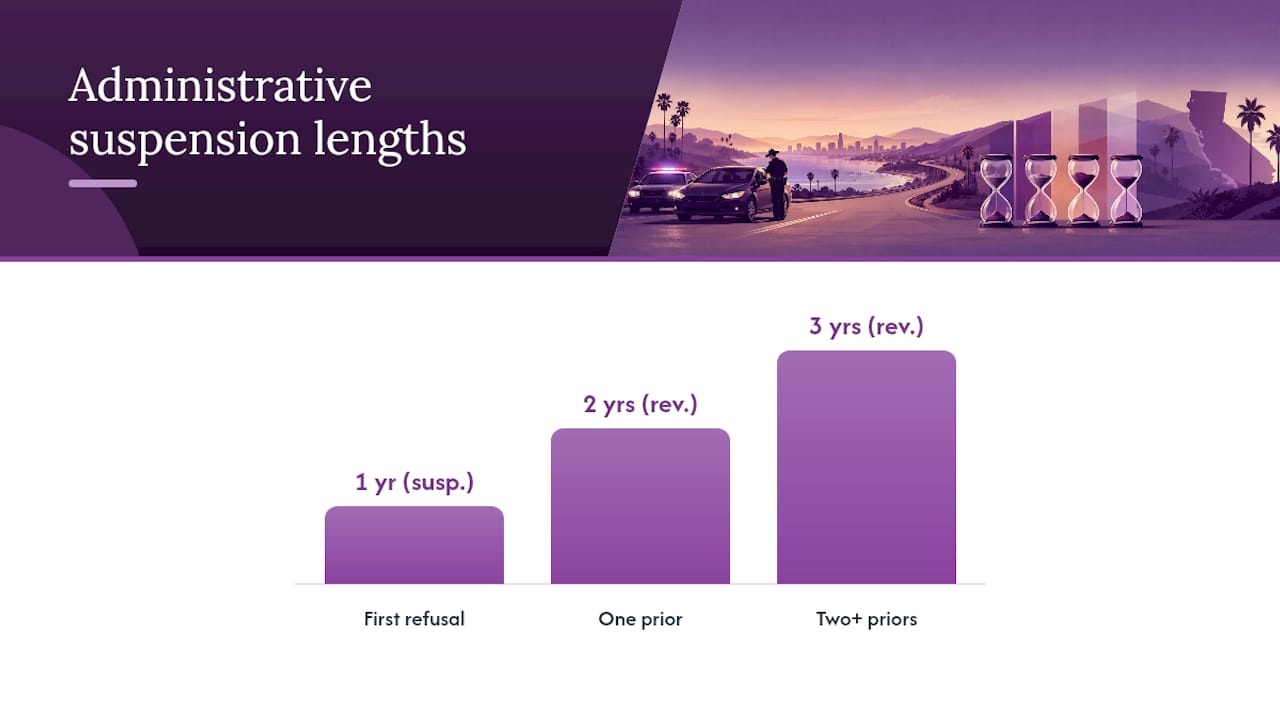
These periods are set directly by VC §23612. Unlike a standard DUI suspension, a refusal suspension does not qualify for a restricted license during the suspension period on a first offense — you lose full driving privileges for the entire year.
Criminal consequences of refusing
Prosecutors treat refusal as evidence of consciousness of guilt. They will argue to the jury that an innocent person would have nothing to hide. That argument is not automatically persuasive, but it shifts the dynamic in a case where the prosecution otherwise has no BAC number to present. As FindLaw notes, refusal does not prevent a DUI prosecution — officers can still testify about driving behavior, field sobriety observations, and physical signs of impairment.
Beyond the evidentiary use, a refusal can trigger sentencing enhancements if you are ultimately convicted. California courts treat refusal as an aggravating factor, which can affect jail time, fines, and probation terms.
Immediate collateral impacts to know:
- Your insurer will likely learn of the suspension through DMV records, which can trigger a rate increase or policy cancellation.
- You will need an SR-22 certificate of financial responsibility to reinstate your license after the suspension period ends.
- An ignition interlock device (IID) may be required as a condition of any restricted driving privilege, depending on the county and the resolution of the criminal case.
- License reinstatement requires completing the suspension period, filing an SR-22, paying reinstatement fees, and in some cases completing a DUI program.
What happens at the DMV hearing and when must you request it?
The 10-day deadline is not a suggestion. Under California law, you have 10 days from the date of arrest to contact the DMV and request an administrative per se (APS) hearing. If you do not request it, the suspension goes into effect automatically on day 31 after your arrest. Requesting the hearing stays the suspension while the hearing is pending, which means you can keep driving legally during that window.
Here is how the process works:
- Request the hearing by calling the DMV Driver Safety Office that serves your area, or submit the request in writing. Keep a copy of everything you send and note the date and time of any phone call.
- Receive a hearing date. Scheduling can take several weeks. The stay of suspension remains in effect until the hearing officer issues a decision.
- Gather your evidence. The DMV hearing examiner will consider the DS 367 form, the officer's sworn statement, breath machine calibration and maintenance logs, and any testimony you or your attorney present.
- Attend the hearing. You or your attorney can cross-examine the officer, challenge the DS 367 admonition, and present evidence that the arrest was unlawful or the refusal was not willful.
- Receive the decision. If the DMV rules against you, you can petition for a writ of mandate in superior court — a step that almost always requires an attorney.
Documents to bring to your DMV hearing:
- A copy of the DS 367 or DS 367M served by the officer
- Any medical records documenting a condition that affected your ability to complete the test
- Names and contact information for any witnesses to the stop or the test administration
- Breath machine calibration and maintenance logs (request these from the arresting agency)
- Proof of employment or hardship if you plan to argue for a restricted license
Pro Tip: Ask your attorney to subpoena the breath machine's calibration and maintenance records before the hearing. Machines that were out of calibration or overdue for service can undermine the officer's account of events, even in a refusal case where no BAC reading exists.
The DMV's administrative process is separate from the California criminal courts, but the evidence gathered for one proceeding often feeds the other. An attorney who handles both tracks simultaneously has a significant advantage.
How do defense lawyers challenge a refusal?
The strongest refusal defenses are documentary. Before any hearing or trial, experienced DUI defense counsel will demand the following:
- The completed DS 367 or DS 367M, including the officer's handwritten notes
- Audio and video recordings of the stop, the advisement, and the test administration
- Breath machine calibration logs and maintenance records
- The officer's training records for chemical test administration
- Hospital intake records if the arrest involved a medical transport
- Any warrant application and supporting affidavit if a nonconsensual blood draw was sought
Core defense strategies
Procedural challenge to the DS 367 admonition. If the officer failed to read the admonition correctly, skipped required language, or did not give you a genuine choice of tests, the refusal may be inadmissible. CHP HPM 70.4 requires verbatim reading — any deviation is documented and challengeable.
Medical incapacity. If a documented medical condition prevented you from completing the breath test, that is not a willful refusal under California law. The DS 367M notation and hospital records are the key evidence here.
Unlawful arrest. VC §23612 only applies to a lawful arrest. If the officer lacked probable cause to arrest you, the implied consent obligation never attached. This is a constitutional argument under the Fourth Amendment that can void both the administrative suspension and the criminal charge.
Chain-of-custody and calibration attacks. Even in a refusal case, attacking the reliability of the breath equipment matters — it undermines the officer's credibility and the prosecution's narrative about what the test would have shown.
At a DMV hearing, an attorney who knows the local hearing officers and the specific breath equipment used by the arresting agency can frame these challenges far more precisely than a driver appearing alone. For a broader look at how defense counsel approaches DUI evidence in California, the testing distinctions between breath, blood, and field sobriety evidence matter at every stage of the case.
Pro Tip: In South Carolina, defense attorneys have noted that breathalyzer administration errors are among the most productive early challenges in DUI cases — the same principle applies in California, where CHP HPM 70.4 sets strict procedural requirements that officers must follow.
What should you do in the first 72 hours after a refusal?
Speed matters here more than in almost any other legal situation. Here is the priority order:
- Request the DMV hearing immediately. Call the DMV Driver Safety Office within 10 days of arrest. Do not wait to see how the criminal case develops — the DMV deadline is independent and unforgiving. Keep written proof of your request.
- Preserve every piece of evidence you can reach. Collect the names and badge numbers of every officer involved. Write down everything you remember about the stop, the advisement, and the test request while it is fresh. If you were at a hospital, request your intake records immediately — hospitals sometimes purge records quickly.
- Avoid statements to your insurance company. You are not required to give a recorded statement about the arrest, and anything you say can be used to deny coverage or raise your rates. Stick to confirming basic facts if you must communicate at all.
- Contact a DUI attorney before your first court date. Bring the DS 367 or DS 367M if you have it, any paperwork the officer gave you at the scene, and any medical records relevant to the test. The attorney needs those documents to evaluate both the DMV and criminal tracks simultaneously.
What happens when breath testing is unavailable or you are unconscious?
Not every refusal situation happens at the roadside with a working breath machine. California law and CHP policy address several variations.
When a breath machine is unavailable, the officer may offer only a blood test. Refusing that blood test is still a refusal under VC §23612, with the same administrative consequences. Per CHP HPM 70.4, officers in that situation should document the unavailability of the breath machine on the DS 367 and proceed with the blood test offer.
If you are unconscious or otherwise incapable of consenting, officers may seek a search warrant for a nonconsensual blood draw. The Fourth Amendment requires a warrant for nonconsensual blood draws in most circumstances following the U.S. Supreme Court's decision in Missouri v. McNeely (2013). CHP policy reflects this: officers are directed to obtain a warrant when time permits and the suspect cannot or will not consent.
If you were transported to a hospital and tests were available there, refusing those tests is treated as a refusal under the DS 367M process. Preserve your hospital intake records immediately — they document your condition at the time and can support a medical incapacity argument if your physical state prevented voluntary participation.
Why refusal cases demand experienced local counsel
The conventional wisdom in DUI defense is that refusing a breath test is always a smart move because it denies the prosecution a BAC number. That framing misses the real cost. A refusal triggers a mandatory one-year suspension with no restricted license option, hands prosecutors an argument about consciousness of guilt, and creates a documentary record on the DS 367 that is very hard to walk back without a specific procedural or medical defense.
What actually changes outcomes in refusal cases is not the decision made at the roadside — it is what happens in the first 10 days after arrest. Attorneys who regularly appear before the specific DMV hearing officers in a given county know which procedural arguments land and which ones get dismissed. They know which breath machines in the local fleet have maintenance histories worth subpoenaing. That local knowledge is not something you can replicate by reading the statute.
The other underestimated factor: the DMV hearing and the criminal case feed each other. Testimony given at a DMV hearing can be used in the criminal trial. An attorney who is managing both tracks simultaneously can protect you from inadvertently creating evidence against yourself in one proceeding while trying to win the other.
Facing a refusal charge? Rubin Law, P.C. can help

A breath test refusal in California puts two clocks running at once: the 10-day DMV hearing deadline and the criminal court calendar. Rubin Law, P.C. handles both tracks from a single Los Angeles office, with attorneys who appear regularly before local DMV hearing officers and in the courtrooms where your criminal case will be decided. That local presence means your attorney already knows the procedural tendencies of the hearing officers and prosecutors you will face.
For a consultation, bring your DS 367 or DS 367M, any police report or paperwork from the arrest, medical records if a health condition affected the test, and any insurance notices you have received. The initial consultation covers the DMV hearing strategy, the criminal defense posture, and the evidence preservation steps specific to your case.
If your 10-day deadline is approaching, contact Rubin Law, P.C. today. The firm serves clients throughout Los Angeles County and can move quickly on urgent DMV requests. You can also review the firm's California DUI defense resources to understand how VC §23152 and the implied consent statute interact before your first meeting.
Sources
The following primary sources were used to build this guide. Each is worth bookmarking if you are managing a refusal case.
- California Code, Vehicle Code - VEH § 23612 | FindLaw
- 2024 California Code Vehicle Code - VEH DIVISION 11.5 - SENTENCING FOR DRIVING WHILE UNDER THE INFLUENCE CHAPTER 4 - Procedures ARTICLE 1 - General Provisions Section 23612.
- HPM 70.4 chapter 5 (California Highway Patrol policy manual)
- Dmv
This article is general information, not a substitute for advice from a qualified lawyer. Consult a qualified legal professional about your own circumstances before acting on anything here.