
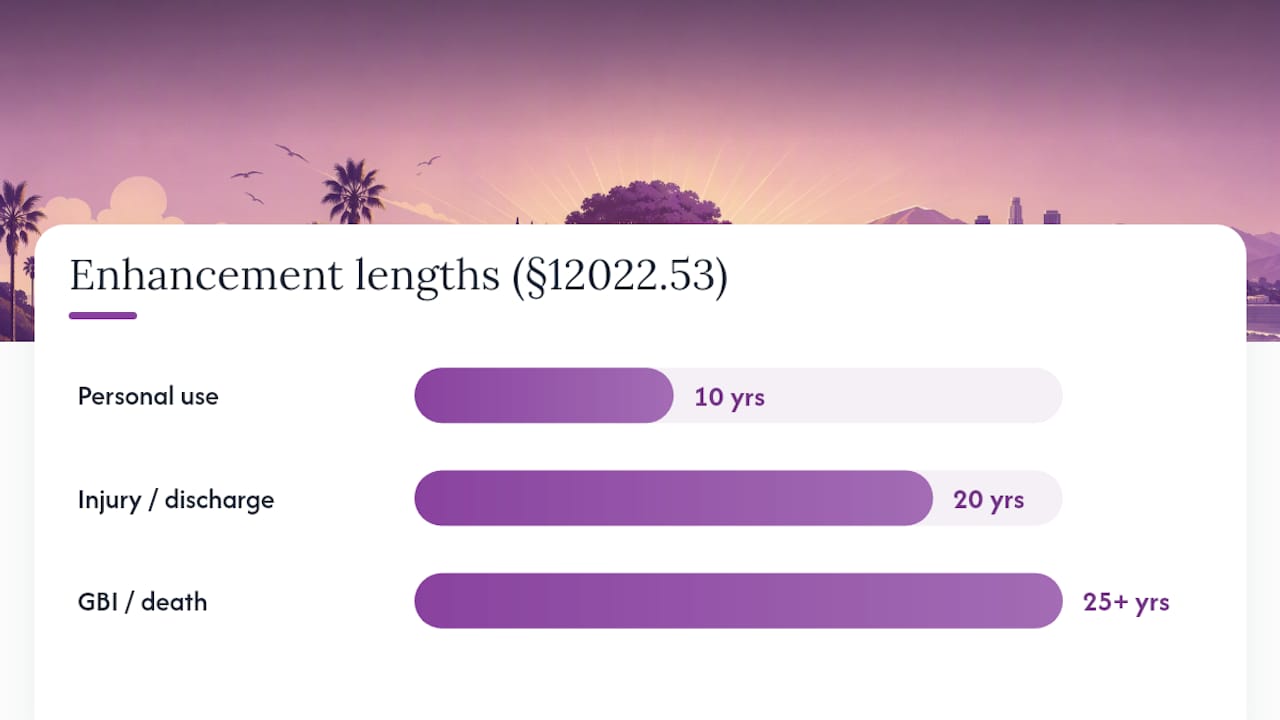
California's 10-20-Life law, codified at Penal Code §12022.53, adds mandatory consecutive prison time of 10, 20, or 25 years to life on top of a base felony sentence whenever a firearm is used in specific crimes. The tier depends entirely on conduct: carrying it, firing it, or hurting someone with it. Judges have gained some power to strike the enhancement since 2018, but the statute still drives sentencing outcomes in serious California cases.
TL;DR:
- The 10-20-Life law applies regardless of whether the firearm is operable or loaded, exposing defendants to additional years even with inoperable guns.
- The highest applicable tier—10, 20, or 25 years to life—is always applied, but only one enhancement can be imposed per offense.
- The law covers specific felonies, including attempted crimes, with prosecutors sometimes overcharging to justify firearm enhancements.
- The recent SB 620 allows judges to dismiss firearm enhancements if certain mitigating factors are proven with evidence before sentencing.
- Defense strategies can focus on challenging firearm use, evidentiary links, and presenting mitigation evidence to influence whether enhancements are imposed or struck.
Table of Contents
- What Does Penal Code §12022.53 Actually Say?
- What Conduct Triggers Each 10-20-Life Tier?
- Which Felonies Actually Trigger 10-20-Life?
- Can an Unarmed Person Get the Gang Enhancement?
- How Do Courts Calculate a 10-20-Life Sentence?
- Can a Judge Strike the Enhancement Under SB 620?
- What Defenses Work Against a 10-20-Life Charge?
- How Does the Enhancement Change Life After Charges Are Filed?
- What Should You Do If You're Charged Under 10-20-Life?
- Why the "Great Weight" Standard Under SB 620 Deserves More Attention
- Facing a 10-20-Life Charge? Here's What to Do Next
- Where to Read the Actual Law Yourself
- Sources
What Does Penal Code §12022.53 Actually Say?
Strip away the legal phrasing and PC §12022.53 does one thing: it punishes firearm use during a specific list of serious felonies with extra prison time added on top of whatever sentence the underlying crime already carries. The statute lists 19 qualifying felonies, including murder, robbery, carjacking, kidnapping, and several sexual offenses.
The subdivisions break down like this:
- Subdivision (b): Personal use of a firearm adds 10 years.
- Subdivision (c): Intentional discharge of a firearm adds 20 years.
- Subdivision (d): Intentional discharge causing great bodily injury or death to someone other than an accomplice adds 25 years to life.
One detail surprises a lot of defendants and their families: the gun does not need to work. The statute's language does not require the firearm to be loaded or even operable for the 10-year enhancement to apply. Pointing an inoperable pistol during a robbery still exposes a defendant to a decade of additional time.
There's also a constitutional wrinkle worth understanding. Under Alleyne v. United States, a firearm allegation under §12022.53 is treated as an element of the enhancement rather than a mere sentencing factor. That means prosecutors must prove it to a jury beyond a reasonable doubt, or the defendant must admit it, rather than have a judge simply find it true after conviction. This single fact shapes a huge amount of pretrial strategy, since forcing the state to prove the allegation at trial carries real risk for the defense.
The full statutory text is worth reading directly rather than relying on a summary, and it pairs naturally with the firm's own breakdown of the PC §12022.53 firearm enhancement for readers who want a second reference point.
What Conduct Triggers Each 10-20-Life Tier?
Only one enhancement applies per person per underlying offense, and it's always the highest tier the facts support. Courts don't stack the 10-year and 20-year enhancements onto the same count.
- 10 years (personal use): Brandishing a firearm, striking someone with it, or pointing it at a victim during the felony.
- 20 years (intentional discharge): Firing the weapon, regardless of whether the shot hits anyone or the property.
- 25 years to life (discharge causing great bodily injury or death): The bullet strikes and seriously injures or kills a person who isn't an accomplice in the crime.
The 25-to-life tier does not require intent to injure. It attaches based on the outcome of the discharge, not the shooter's specific goal at the moment they pulled the trigger.
The great bodily injury threshold in that top tier connects to a separate statute, PC §12022.7, which defines what counts as "great bodily injury" for these purposes. A broken bone from a fall during a struggle reads differently than a gunshot wound, and that distinction matters when prosecutors are deciding which tier to charge.
The anti-stacking rule cuts both ways for defendants. It caps exposure from §12022.53 itself to one enhancement per count, but it does not prevent prosecutors from charging that single enhancement alongside other firearm statutes or gang enhancements tied to different legal theories. Understanding which enhancement applies, and why, is often the first fight in any firearm case.
Which Felonies Actually Trigger 10-20-Life?
The enhancement doesn't attach to every crime involving a gun. It only applies to the specific felonies the legislature listed, plus attempts to commit those felonies.
Common triggering offenses include:
- Murder and attempted murder
- Robbery and carjacking
- Kidnapping
- Rape and other specified sexual offenses
- Mayhem
- Certain drive-by shooting and assault offenses
- Any felony punishable by death or life imprisonment
That last category is a catchall. If the underlying crime carries a potential life sentence on its own, a firearm used during that crime typically qualifies for the enhancement even if the specific offense isn't named elsewhere on the list.
Attempt crimes count too. Someone charged with attempted robbery who used a firearm still faces the enhancement, even though the robbery itself was never completed.
Getting the underlying offense identification right is often where a defense case is won or lost. Prosecutors sometimes overcharge the base felony to justify adding the enhancement, and a defense attorney who catches a misclassified charge, say, a simple assault mislabeled as a §12022.53-eligible offense, can eliminate years of exposure before the case ever reaches sentencing.
Can an Unarmed Person Get the Gang Enhancement?
Yes, and this is one of the least understood parts of the law. Subdivision (e) allows the 10-20-Life enhancement to apply to a defendant who never touched a gun, as long as the crime was gang related and someone else in the group used a firearm.
To trigger this exception, prosecutors must prove the elements required under PC §186.22, California's gang enhancement statute, showing the crime was committed for the benefit of, or in association with, a criminal street gang. If that showing succeeds and any participant in the crime used a firearm, every principal, armed or not, can face the same enhancement as the shooter.
That's a harsh result for someone who acted as a lookout or getaway driver and never held a weapon.
- Defense counsel often challenges whether the group actually qualifies as a "criminal street gang" under the statutory definition.
- Counsel can dispute whether the crime was committed to benefit the gang, rather than for personal reasons unrelated to gang membership.
- Identification evidence tying the defendant to the group at all is frequently contestable, particularly in cases built on informant testimony.
Appellate decisions like People v. Bland have shaped how courts apply these gang-related firearm rules, and that case law continues to inform how defense attorneys challenge the exception.
How Do Courts Calculate a 10-20-Life Sentence?
Sentencing math under §12022.53 follows a set sequence, and understanding the order matters because each step is a separate opportunity for defense advocacy.
Step one is the base term. Under PC §1170 and Judicial Council Rule 4.420, the judge selects the lower, middle, or upper term for the underlying felony based on aggravating and mitigating circumstances. Rule 4.420 limits when a court can justify an upper term, requiring specific findings on the record.
Step two adds the enhancement as a separate, consecutive block. It does not run alongside the base sentence; it stacks on top of it.
| Base term example | Enhancement tier | Total minimum exposure |
|---|---|---|
| 5 years (robbery, middle term) | 10 years (personal use) | 10 years |
| — | 20 years (intentional discharge) | 26 years |
| 7 years (attempted murder) | 25 years to life (GBI/death) | 25 years to life |
Step three is the sentencing hearing itself, governed by Rule 4.433, which lists the specific matters a judge must address on the record, including whether an enhancement will be imposed or stricken.
The distinction between determinate and indeterminate sentencing matters enormously here. A determinate term has a fixed release date reduced by credits. An indeterminate life term, the kind the 25-to-life tier produces, sends a defendant before the Board of Parole Hearings for a suitability determination rather than an automatic release date. The CDCR's sentencing and parole resources walk through how that parole suitability process actually works.
Can a Judge Strike the Enhancement Under SB 620?
Yes, since January 1, 2018. Senate Bill 620 amended §12022.53 to give trial judges discretion to strike or dismiss a firearm enhancement "in the interest of justice" under Penal Code §1385, something that was previously mandatory and unwaivable.
Revisions to §1385 now require judges to give "great weight" to certain mitigating circumstances when deciding whether to strike an enhancement, unless doing so would endanger public safety.
Factors carrying that great weight typically include:
- The firearm was unloaded or otherwise inoperable
- The defendant was under 26 at the time of the offense
- The defendant experienced childhood trauma
- Mental illness contributed to the offense
- The total sentence, including enhancements, would exceed 20 years
Pro Tip: Courts don't strike enhancements automatically just because a mitigating factor technically applies. Effective SB 620 motions compile documented evidence, clinical records, trauma history, firearm inoperability reports, rather than simply asserting the factor exists.
Building that kind of mitigation packet takes real preparation. It typically means gathering clinical and psychological records, testimony about trauma history, forensic evidence on the weapon's condition, juvenile records, and documentation of community ties, all assembled before the sentencing hearing so the judge has something concrete to weigh against the enhancement.
What Defenses Work Against a 10-20-Life Charge?
Several defense strategies target the enhancement specifically, separate from any defense to the underlying felony itself.
- No personal use. If the defendant never touched, brandished, or aimed the firearm, the 10-year tier doesn't apply, even if a codefendant had a gun.
- No intent to discharge. A weapon that fired accidentally during a struggle may not meet the "intentional discharge" standard the 20-year tier requires.
- Self-defense or justification. If the firearm use was legally justified, the enhancement can fall along with the underlying charge; California's self-defense laws set out when force, including armed force, is legally protected.
- Identification challenges. Contesting whether the defendant is actually the person who possessed or used the firearm, particularly in multi-defendant cases.
- Underlying felony challenges. If the base felony charge doesn't hold up, the enhancement has nothing to attach to.
Procedurally, defense attorneys also file motions to dismiss or exclude firearm allegations before trial, negotiate pleas structured to avoid enhancement exposure entirely, and time SB 620 mitigation motions to land when a judge is most receptive.
Pro Tip: Forensic evidence, ballistics reports, surveillance footage, and gunshot residue testing, often does more to undercut a firearm allegation than witness testimony alone. Eyewitnesses routinely misjudge who held a weapon during a chaotic, fast-moving crime.

How Does the Enhancement Change Life After Charges Are Filed?
An enhancement this large reshapes everything that follows an arrest, not just the eventual sentence.
- Plea bargaining shifts. Because the enhancement is consecutive and can add decades, defense priorities move toward negotiating around it entirely or building an SB 620 record, rather than simply arguing the underlying facts.
- Trial risk increases. Since the firearm allegation must be proven to a jury as its own element, going to trial means the state has to prove both the felony and the gun use separately, which sometimes creates leverage for the defense.
- Collateral consequences stack up. A felony conviction with a firearm enhancement can trigger immigration consequences for noncitizens, loss of professional licenses, employment barriers, and, for qualifying sex offenses, registration requirements.
- Parole prospects vary widely. Determinate sentences run to a fixed release date; the 25-to-life tier means appearing before the Board of Parole Hearings, where suitability, not just time served, decides release.
Families often underestimate how much the enhancement, not the underlying felony, drives these downstream effects.
What Should You Do If You're Charged Under 10-20-Life?
The choices made in the first 48 hours after an arrest often matter more than anything that happens months later.
- Say nothing to police without an attorney present. Anything said during questioning, even something meant to sound helpful, can be used to establish personal use or intent to discharge.
- Preserve evidence immediately. Photos, texts, witness contact information, and your own written recollection of events fade fast; write down what you remember as soon as possible.
- Contact defense counsel before your arraignment. An attorney can begin evidence review, identify weaknesses in the firearm allegation, and start planning pretrial motions right away.
- Expect a staged defense process. Counsel typically reviews police reports and forensic evidence first, files pretrial motions challenging the firearm allegation next, then builds SB 620 mitigation materials in parallel in case the case proceeds toward sentencing.
Most defense attorneys can offer a consultation within days, and that early conversation shapes everything that follows.
Why the "Great Weight" Standard Under SB 620 Deserves More Attention
Most explanations of 10-20-Life stop at the tiers and the numbers, but the real fight in these cases increasingly happens at the SB 620 stage, and I think that part gets undersold. Judges aren't just permitted to strike an enhancement anymore; §1385 tells them to give certain mitigating factors "great weight." That's a meaningfully higher bar than mere discretion, and too few defendants understand it exists until it's almost too late to build the record for it.
An effective approach to these cases involves frequent courtroom appearances to anticipate how a specific judge or prosecutor's office tends to weigh mitigation before the hearing, preparing constitutional challenges to firearm allegations where evidence is thin, and assembling mitigation materials well before sentencing rather than scrambling once a conviction occurs. Clients should expect thorough preparation from any attorney handling a 10-20-Life case and inquire about it during a consultation.
— Jake
Facing a 10-20-Life Charge? Here's What to Do Next
If you or someone in your family is facing a firearm enhancement, the difference between a decade and two-plus decades in prison often comes down to how early a defense attorney gets involved. Successful defense often involves frequent courtroom appearances, familiarity with local prosecutors, and constitutional challenges built before the sentencing hearing, rather than after a plea is already signed.
A consultation typically starts with a review of the police report, any forensic evidence tied to the firearm allegation, and your own account of events, so bring anything you have: court paperwork, arrest documents, and written notes about what happened. Everything discussed stays confidential. If you're weighing your options after an arrest involving a firearm enhancement, start with the firm's criminal defense practice overview to see how Rubin Law approaches cases like yours, and reach out for a case evaluation before your next court date.
Where to Read the Actual Law Yourself
Reading the primary sources directly, rather than relying only on summaries, helps you follow along with your own attorney's strategy.
- PC §12022.53: the full text of the 10-20-Life enhancement statute.
- PC §1170: governs determinate sentencing and base term selection.
- Rule 4.420 and Rule 4.433: Judicial Council rules on term selection and sentencing hearing procedure.
- SB 620 legislative text: the 2018 amendment giving judges discretion to strike enhancements.
- CDCR sentencing and parole resources: explains determinate versus indeterminate sentencing and parole suitability.
This article is general information, not a substitute for advice from a qualified lawyer. Consult a qualified legal professional about your own circumstances before acting on anything here.
Sources
- California Penal Code § 12022.53
- SB 620 legislative information (2017–2018)
- Sentencing, Incarceration & Parole of Offenders - CDCR
- Rule 4.420. Selection of term of imprisonment
- Rule 4.433. Matters to be considered at time set for sentencing