
Yes, defenses to a solicitation of minor charge exist, but which one applies depends entirely on the facts, the statute charged, and how the investigation was conducted. If you're facing this charge or believe you're under investigation, stop talking to law enforcement now, preserve every device and account tied to the case, and contact a criminal defense attorney before you say another word. Everything that follows, discovery, forensic review, suppression motions, gets built from that first decision.
TL;DR:
- Defense strategies depend heavily on the facts, the specific statutes charged, and the conduct of law enforcement during investigation.
- Federal law criminalizes using interstate channels with no requirement for a real child's involvement, as long as the defendant believed one was present.
- Evidence weaknesses often lie in police procedural flaws, such as misrepresented timelines, escalated sexual content, and inconsistent decoy profiles.
- Valid defenses include entrapment, mistaken identity, lack of intent, and narrowly applicable statutory exceptions; forensic experts and discovery motions are critical.
- The sentencing and long-term consequences often involve mandatory registration, which can last for years or a lifetime, and influence plea negotiations significantly.
Table of Contents
- Understanding a Solicitation of Minor Defense: Core Elements and Statutes
- How Sting Operations and Decoy Investigations Build These Cases
- Practical Defenses: Entrapment, Intent, and Mistaken Identity
- Digital Evidence: Where Forensic Challenges and Discovery Motions Matter
- Penalties, Registration, and the Consequences That Outlast the Case
- How Defense Counsel Builds a Case: A Step-by-Step Roadmap
- Case Law That Shapes Solicitation Defenses Today
- Solicitation vs. Grooming vs. Child Pornography: Why the Defense Differs
- Mental Health Evaluations and Capacity in Building a Defense
- Recent Legal Changes and High-Profile Cases Reshaping Defense Strategy
- Attorney Perspective: Priorities and Realistic Expectations
- How Rubin Law, P.C. Approaches Solicitation Defense in Los Angeles
- Sources
- FAQ
Understanding a Solicitation of Minor Defense: Core Elements and Statutes
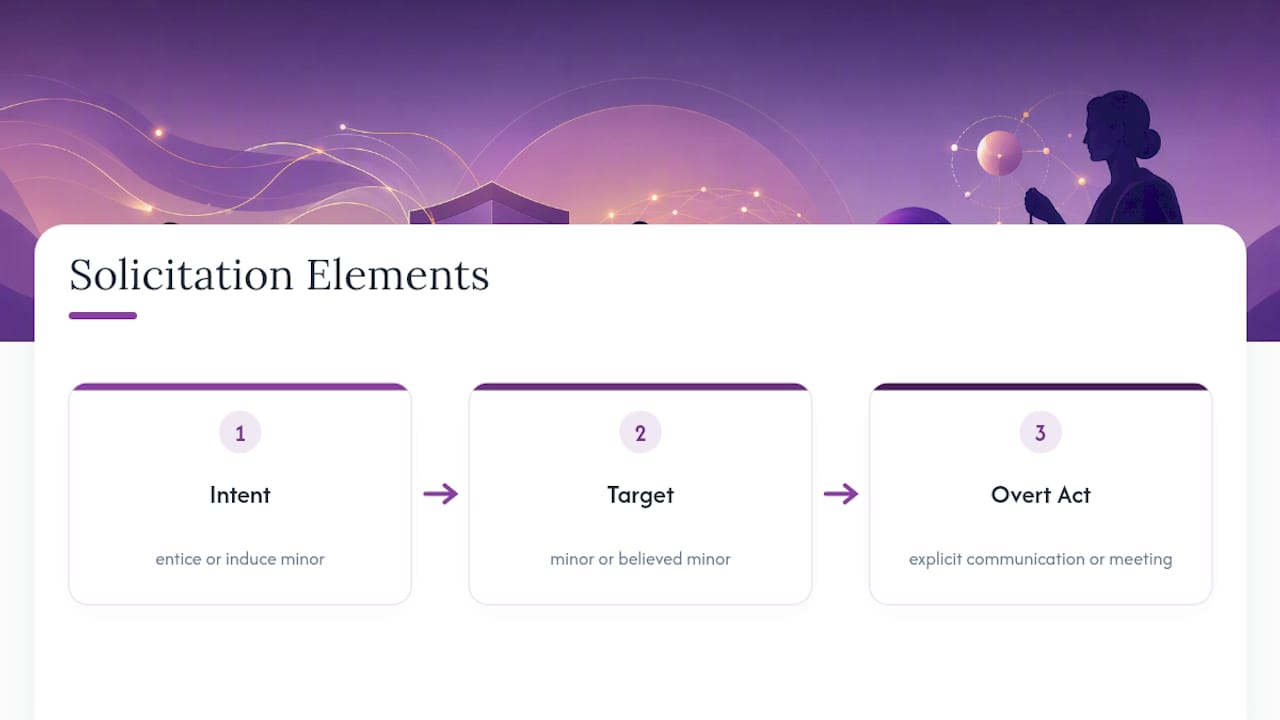
A solicitation of minor defense starts with attacking what prosecutors must actually prove. Most statutes require three things: intent to entice or induce a minor into sexual conduct, a target who is a minor or who the defendant believed was a minor, and an overt act, sexually explicit communication, or a step toward a meeting.
Federal law reaches further than most people expect. 18 U.S.C. §2422 and §2423 criminalize using interstate commerce, meaning phones, apps, the internet, to persuade or coerce a minor into unlawful sexual activity, and prosecutors can charge someone even when no real child existed, so long as the defendant believed one did.
State statutes vary in structure. Texas Penal Code §33.021, for example, splits the offense into sexually explicit communication and solicitation-to-meet as separate crimes, each with different available defenses. California treats arranging a meeting with a minor under PC 288.4 as its own offense too. Close-in-age exceptions exist in some states, but they're narrow, statute-specific, and usually don't cover explicit communication charges or educator-student relationships.
How Sting Operations and Decoy Investigations Build These Cases
Most solicitation cases originate online, not in person. Investigators run undercover profiles on dating apps, social media, gaming platforms, and messaging services, then wait for someone to initiate or escalate contact. Because federal and state law both allow prosecution based on the defendant's belief that the other person was a minor, an adult officer posing as a 14-year-old can still support an arrest.
That structure creates real defense openings, if you know where to look:
- Warrant affidavits often contain gaps between what the officer claims and what the chat logs actually show.
- Officers sometimes escalate sexual content themselves rather than merely responding to it.
- The timeline of who introduced a meeting location or explicit topic first frequently gets misrepresented in police reports.
- Decoy profiles occasionally list ages inconsistently across platforms, creating doubt about what the defendant actually saw.
These procedural details rarely make headlines, but they're often where a case gets won or lost.
Practical Defenses: Entrapment, Intent, and Mistaken Identity
Not every defense fits every case, and knowing which one your facts support matters more than knowing all of them exist.
- Entrapment. This defense asks whether law enforcement induced a crime the defendant wasn't predisposed to commit. Persistent, escalating pressure from an undercover officer despite the defendant's resistance supports entrapment; simply providing an opportunity to offend does not.
- Lack of intent. Prosecutors need proof of genuine intent to entice, not ambiguous or fantasy-driven roleplay. Context, the full message history, tone, and whether the defendant ever took a concrete step toward meeting, often decides this.
- Mistaken identity or a compromised account. Shared devices, hacked accounts, and spoofed IP addresses can put someone else's words in your mouth. Forensic analysis of device access logs and alibi evidence can separate the account holder from the actual sender.
- Statutory exceptions. Marriage or close-in-age defenses exist in some states but apply narrowly. They generally don't touch sexually explicit communication charges or cases involving a position of trust like a teacher or coach.
Pro Tip: Save everything before you talk to anyone, including your attorney. Screenshots don't preserve metadata the way a forensic image does, and metadata is often what proves who actually sent a message and when.
Digital Evidence: Where Forensic Challenges and Discovery Motions Matter
Digital evidence is the backbone of almost every solicitation case, and it's also the most vulnerable part of the prosecution's file. Chat logs, server records, device images, IP logs, and account ownership records all need to line up, and they frequently don't.
Defense attorneys look for specific weaknesses in this evidence:
- Chain-of-custody gaps between when a device was seized and when it was imaged.
- Warrant applications that overstate probable cause or omit context favorable to the defendant.
- Subpoenas to platforms that reach further than the warrant actually authorized.
- Metadata that contradicts the timeline in the police report.
Authentication and chain-of-custody problems are among the most common grounds for challenging digital evidence in these prosecutions. Early, aggressive discovery requests, demanding the full warrant affidavit, raw server logs, and unredacted device images, often surface these gaps before trial. When they do, suppression motions under the Fourth Amendment or a Brady violation claim for withheld exculpatory evidence can gut the prosecution's case before a jury ever hears it.
Penalties, Registration, and the Consequences That Outlast the Case
Penalties for solicitation charges swing widely based on the statute charged, the alleged victim's age, and aggravating factors like school-zone enhancements or crossing state lines to meet. Federal charges under §2422 and §2423 carry mandatory minimums that state charges often don't.
The heavier long-term cost is usually registration, not incarceration. A conviction frequently triggers mandatory sex-offender or predatory-offender registration, which follows a person for years or a lifetime and reshapes where they can live, work, and in some cases whether they can remain in the country if immigration status is involved. This is exactly why so many plea negotiations focus less on avoiding jail time and more on avoiding a registerable offense altogether, sometimes through a plea to a lesser, non-registerable charge.
How Defense Counsel Builds a Case: A Step-by-Step Roadmap
Effective defense work follows a sequence, and skipping steps costs leverage later.
- Immediate intake: meet privately with the client, secure devices and accounts before they're altered, and formally request all warrants, affidavits, and charging documents.
- Discovery and investigation: file Rule 5/Brady discovery motions early, subpoena server logs, retain forensic experts to image devices, interview witnesses, and visit any physical location referenced in the case.
- Motion practice: challenge authentication of chat logs, move to suppress improperly obtained evidence, and litigate any Brady violations before trial.
- Plea or diversion analysis: weigh whether pretrial diversion or a negotiated plea to a non-registerable offense better serves the client than trial risk.
Pro Tip: Ask your attorney directly whether they've litigated a suppression motion on similar digital evidence before. Courtroom repetition with these specific fact patterns, warrant challenges, chain-of-custody fights, matters more than general experience.
Case Law That Shapes Solicitation Defenses Today
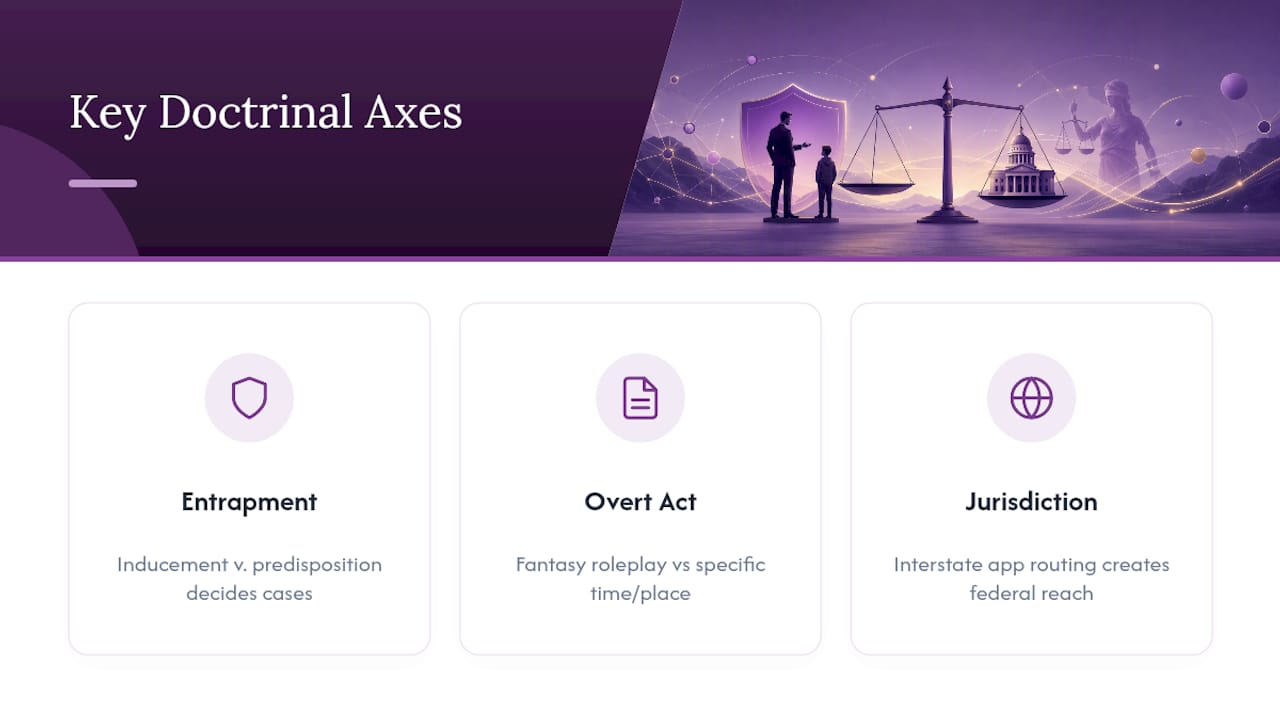
Courts have spent two decades refining how solicitation statutes apply to digital communication, and the resulting precedent shapes almost every defense strategy in play today. Entrapment case law consistently draws a line between officers who merely provide an opportunity and officers who actively manufacture criminal intent through repeated, escalating pressure. That distinction, inducement versus predisposition, still decides a large share of contested cases.
Courts have also wrestled with what counts as an "overt act" sufficient to move a case from protected speech into criminal solicitation. Some rulings have found that explicit fantasy roleplay without any concrete step toward a meeting falls short of the statutory threshold, while others have found that even a single specific time-and-place proposal satisfies it. This inconsistency across jurisdictions is exactly why the wording and sequence of messages gets scrutinized so closely during discovery.
Rulings on jurisdictional reach have mattered just as much. Because federal statutes hinge on use of interstate commerce, courts have had to define what qualifies, an app server routed through another state has been enough in several rulings, which explains why federal exposure attaches to conduct that might otherwise seem purely local. Defense teams track these rulings closely because a shift in how one appellate court defines an element can open or close an argument overnight. This is also where combining constitutional motions with forensic expert testimony has produced the strongest outcomes, whether that means a suppression, a dismissal, or a plea that avoids registration.
Solicitation vs. Grooming vs. Child Pornography: Why the Defense Differs
These charges get lumped together in public conversation, but the defense strategy for each is distinct, and confusing them can lead to bad legal advice.
Solicitation charges hinge on communication and intent toward a specific act, sending a message, proposing a meeting, describing sexual conduct. The defense fight centers on message content, timing, and who initiated escalation, which is why chat log authentication and entrapment arguments dominate.
Grooming allegations, by contrast, often involve a longer relationship and a pattern of behavior rather than a single exchange. Defense here focuses less on any one message and more on context: the nature of the relationship, whether contact had a legitimate basis (coaching, tutoring, family friendship), and whether the pattern alleged actually matches grooming behavior or reflects an innocent relationship prosecutors have recast after the fact.
Child pornography charges turn on possession, production, or distribution of specific images or files, an entirely different evidentiary fight. Defense strategy shifts toward forensic questions: who had access to the device, whether files were automatically cached without the user's knowledge, and whether metadata proves knowing possession versus incidental download. These cases rarely benefit from an entrapment argument the way solicitation cases sometimes do, since there's usually no undercover officer inducing the offense, just a file on a server or device.
Because the elements, evidence, and defenses diverge so sharply, an attorney building a solicitation defense needs a different playbook than one defending a possession charge, even when both appear in the same case.
Mental Health Evaluations and Capacity in Building a Defense
Mental health evidence rarely serves as a stand-alone defense in solicitation cases, but it plays a real role in shaping strategy, particularly around intent and competency. A formal evaluation can help establish whether a defendant had the capacity to form the specific intent the statute requires, which matters most in cases involving impulsivity, cognitive impairment, or a documented psychiatric condition that bears directly on decision-making.
Competency to stand trial is a separate question from intent, and it comes up more often in juvenile cases. Juvenile defense practice calls for competency assessment where needed, alongside private client interviews and thorough investigation, before any plea decision gets made. A young client who doesn't understand the proceedings against them can't meaningfully participate in their own defense, and that gap has to be addressed before the case moves forward.
Mental health findings also factor heavily into plea and diversion negotiations. Prosecutors and judges sometimes treat a documented condition, especially one tied to compulsive online behavior or an underlying disorder, as relevant to sentencing alternatives, including treatment-based diversion instead of straight incarceration. None of this replaces a factual defense on the elements of the charge, but it often shapes what outcome is realistic once the evidentiary fight plays out.
Recent Legal Changes and High-Profile Cases Reshaping Defense Strategy
Legislatures have expanded solicitation statutes steadily over the past several years, adding new enhancements for school-zone proximity, travel-to-meet conduct, and repeat offenses, while lawmakers in multiple states have pushed to close perceived gaps around AI-generated content and deepfake material involving minors. Each expansion adds new elements prosecutors must prove, which in turn creates new angles for defense counsel to test.
High-profile sting operations, particularly ones involving media-organized decoy encounters, have also pushed courts to scrutinize entrapment claims more carefully. When private groups or livestreamers coordinate with, or operate independently of, law enforcement to lure suspects, courts have had to work out whether that conduct meets the same due process standards as police-run stings. That scrutiny has given defense attorneys more room to challenge how an investigation was conducted, not just what it produced.
Digital privacy rulings have shifted the discovery landscape too. Courts continue to refine how broadly a warrant for one account or device can reach into cloud backups, linked accounts, and third-party servers, and overbroad requests remain a frequent suppression target. Defense teams that stay current on these rulings, rather than relying on outdated assumptions about what's discoverable, tend to spot suppression opportunities that older case files miss entirely.
Attorney Perspective: Priorities and Realistic Expectations
Protecting your rights starts the moment you suspect an investigation, not after an arrest. Say nothing to police without counsel present, and let your attorney control what gets shared and when. Expect a discovery-heavy first phase, then motions, then a plea or trial decision, usually over months, not weeks. Clients who document everything and resist the urge to explain themselves to investigators give their attorney far more to work with.
— Jake
How Rubin Law, P.C. Approaches Solicitation Defense in Los Angeles
Facing a solicitation charge means facing prosecutors who file these cases often and courtrooms that move fast. Rubin Law, P.C. built its practice around frequent courtroom appearances in Los Angeles County, which means familiarity with how local judges rule on suppression motions and how prosecutors typically approach plea negotiations in these cases.

The firm's sex crimes defense practice covers solicitation charges, along with related California solicitation matters under PC §653f and juvenile-specific defense needs. Rubin Law's approach leans on constitutional challenges to search and seizure, aggressive discovery requests, and pre-file intervention when a case hasn't been formally charged yet, along with diversion program strategies aimed at avoiding registration where the facts support it.
If you're bringing a case to an initial consultation, bring every document you have: any warrant or notice from law enforcement, your phone and account access information, and a written timeline of contact before you speak to anyone else. Reach out through Rubin Law's criminal defense page to schedule a consultation and get a strategy built around your specific facts.
This article is general information, not a substitute for advice from a qualified lawyer. Consult a qualified legal professional about your own circumstances before acting on anything here.
Sources
- Solicitation of a Minor Federal Laws - 18 USC 2422 and 2423
- Juvenile defense attorney practice guide (University of South Carolina)
- Online Solicitation of a Minor in Texas
- How to Win a Solicitation of a Minor Case in Florida - Leppard Law
FAQ
Does a Soliciting Charge Go on Your Record?
Yes, a conviction for solicitation of a minor creates a permanent criminal record and, in most states, triggers mandatory sex-offender registration that follows you for years. Even an arrest without conviction can appear on background checks unless the case is later expunged or sealed.
Is Solicitation of a Minor a Federal Crime?
It can be. 18 U.S.C. §2422 and §2423 make it a federal offense to use interstate commerce, including phones and the internet, to entice a minor into unlawful sexual activity, and federal prosecutors can bring charges even without a real child involved if the defendant believed one existed. Many cases are also prosecuted under state statutes instead, depending on how the investigation started.
Can You Get Jail Time for Soliciting a Minor?
Yes, penalties range from misdemeanor-level consequences to lengthy federal mandatory minimums, depending on the statute, the alleged victim's age, and any aggravating factors like school-zone enhancements. Sentencing outcomes vary significantly by jurisdiction and by whether the case proceeds under state or federal law.
How Do You Beat a Solicitation Charge?
There's no single approach that works in every case, but common defense strategies include challenging entrapment, disputing intent, proving mistaken identity through forensic evidence, and filing suppression motions over warrant or chain-of-custody problems. A defense attorney who reviews the specific facts, the messages, the investigation's conduct, and the digital evidence, can identify which defenses actually apply to your case.
What Should I Do Immediately If I'm Under Investigation?
Stop communicating with law enforcement without an attorney present, and preserve your devices and accounts rather than deleting anything, which can create separate legal problems. Contact a criminal defense firm like Rubin Law, P.C. as early as possible, ideally before charges are filed, since pre-file intervention can sometimes prevent a case from being charged at all.