
The two documents you need are the 2026 Felony Bail Schedule and the 2026 Misdemeanor Bail Schedule, both published by the Los Angeles Superior Court. These are the controlling pre-arraignment documents for bail amounts in LA County, governed by Penal Code §§ 1269b and 1275.
The most common default amounts from the current schedules:
- Unlisted misdemeanors: a standard uniform bail amount
- Unlisted infractions: a standard uniform bail amount
- Wobblers (offenses chargeable as either misdemeanor or felony): a set uniform bail amount
- Felony base bail scales from amounts set by offense severity, beginning at a specified level for three-year top term offenses and increasing to a maximum for life sentence offenses, before enhancements are added
One important context note: the Los Angeles Superior Court's Pre-Arraignment Release Protocols now assign many non-violent, non-serious felony and misdemeanor arrests to Cite and Release (CR), Book and Release (BR), or Magistrate Review (MR) status rather than a money bail amount. If you don't see a dollar figure for a particular charge, that protocol may be why.
Table of Contents
- What do the felony and misdemeanor bail schedules actually contain?
- How courts and magistrates use the bail schedule
- How to post bail in Los Angeles County
- Where can you find and verify the current bail schedule?
- How Rubin Law, P.C. can help after an arrest
- Key Takeaways
- The part most people miss about bail in Los Angeles
- Rubin Law, P.C. is ready to help right now
- Useful sources
What do the felony and misdemeanor bail schedules actually contain?
Each schedule is a structured PDF with columns for the Penal Code section (or other code), the offense description, and the bail amount. Reading them correctly requires knowing where to look beyond the main table.
Misdemeanor and infraction schedule structure
The misdemeanor/infraction schedule opens with a uniform bail codes table that covers offenses from multiple California codes (Business & Professions, Civil, Food & Agricultural, and others). After the uniform table, the schedule lists specific code sections with individual amounts. Footnotes appear throughout and flag exceptions, mandatory minimums, and special conditions. If a code section isn't listed at all, the unlisted rules apply.
The schedule's purpose is to fix a bail amount for pre-arraignment release. Once a defendant is arraigned, a judicial officer has discretion under Penal Code § 1269b(b) to raise, lower, or eliminate money bail entirely based on the facts of the case.
Felony schedule structure
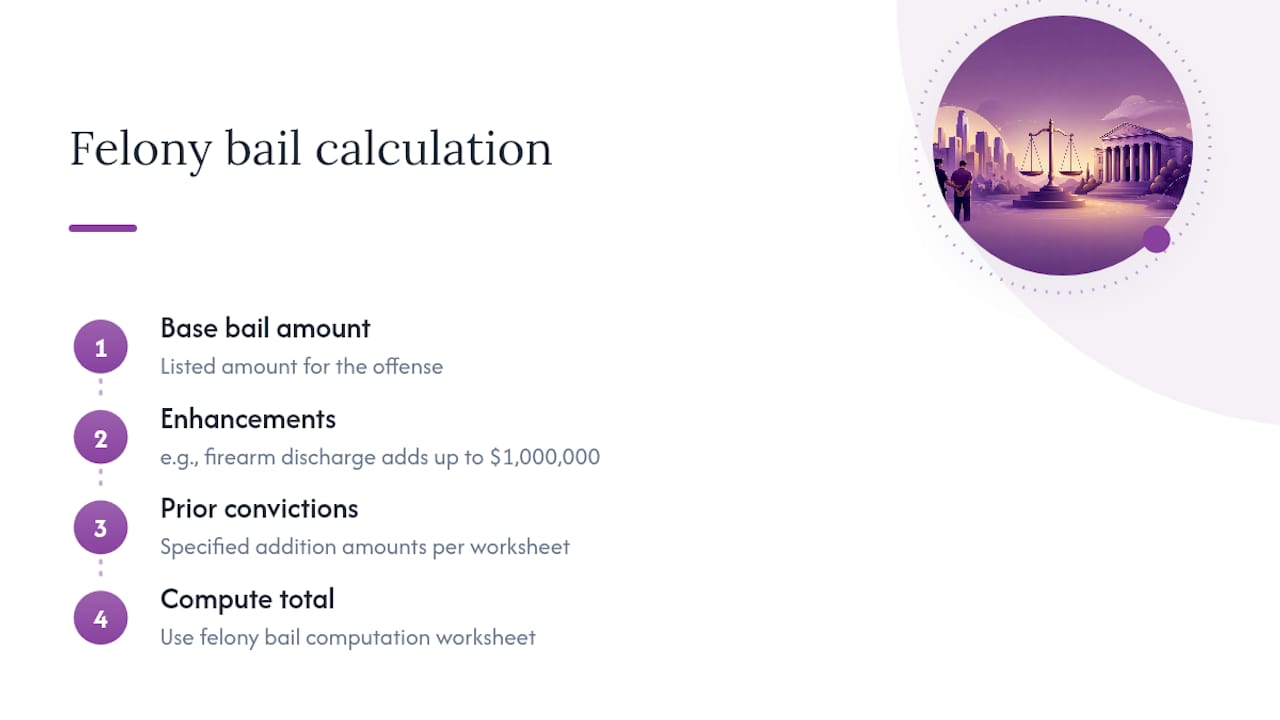
The felony bail schedule works differently. It lists a base bail amount for each offense, then specifies enhancement amounts to be added on top. A firearm discharge causing great bodily injury or death, for example, adds up to $1,000,000 to the base. The schedule includes a felony bail computation worksheet that practitioners use to calculate the total amount before posting. Prior convictions also add specified amounts per the worksheet.
How courts and magistrates use the bail schedule
The bail schedule is a pre-arraignment tool, not a final determination. Understanding this distinction matters more than memorizing any specific dollar amount.
Statutory framework:
- Penal Code § 1269b authorizes the court to adopt a bail schedule and allows a magistrate to set bail in the amount listed before arraignment.
- Penal Code § 1275 directs the court to consider public safety, the seriousness of the offense, the defendant's prior record, and the probability of appearance when setting bail.
- Penal Code § 815a governs the authority of a magistrate to set bail at first appearance.
Practical rules that affect the amount:
- A judge or magistrate can set bail higher or lower than the schedule amount at any time, based on the facts presented.
- When multiple charges are filed, the standard rule uses the single highest bail amount, not a sum of all charges. The exception: separate victims or separate dates can justify stacking amounts.
- Enhancements and prior convictions are added to felony base bail per the computation worksheet before the total is posted.
- Penal Code § 1270.1 lists specific offenses that make a defendant ineligible for non-financial pre-arraignment release, so the protocols don't apply to everyone.
The court's shift toward risk-based release grew partly from experience with COVID-19 Emergency Bail Schedules, which reduced bail to $0 for many non-violent offenses and generated data on failure-to-appear and rearrest rates. The current Pre-Arraignment Release Protocols reflect that data.
Pro Tip: Having an attorney present at first appearance, or even before charges are filed, gives you the best shot at influencing how the magistrate exercises discretion. A pre-file intervention can sometimes prevent a high bail amount from being set in the first place. Rubinlawpc handles pre-trial diversion and first-appearance representation across LA County.
How to post bail in Los Angeles County
Once you have the schedule amount, the process moves fast. Here's the sequence:
- Get the exact amount. For misdemeanors, look up the code section in the schedule. For felonies, use the computation worksheet: base bail plus enhancements plus any prior-conviction additions.
- Confirm the booking location. LA County jails (Men's Central Jail, Twin Towers, Century Regional Detention Facility, and others) each have their own cashier windows and hours. The arresting agency's booking number is required.
- Choose your posting method:
- Cash or cashier's check: Pay the full amount at the jail cashier or court clerk's window. You get it back at the end of the case, minus any court-ordered fees.
- Surety bond (bail bondsman): A licensed bondsman posts the full amount in exchange for a non-refundable premium. California sets the premium rate by statute, so confirm the current rate with the bondsman directly.
- Own recognizance (OR/PR) release: A judge or magistrate releases the defendant without money bail, typically with conditions like check-ins or travel restrictions. Under the current pre-arraignment protocols, CR and BR releases happen before arraignment for qualifying offenses.
- Bring the right documents. You'll need a government-issued photo ID, the booking number, the arresting agency's name, and the full bail amount in an accepted payment form.
- Expect additional costs. Booking fees and administrative charges vary by facility. These are separate from the bail amount itself.
A common practitioner workflow: confirm the schedule entry, compute the total with enhancements, verify the booking location and its hours, then contact a bondsman or the court cashier with the exact figure and required documents. That sequence cuts posting time significantly. Rubinlawpc's guide to bail hearings in California walks through the review process if you need to contest the amount after posting.
Where can you find and verify the current bail schedule?
The Los Angeles Superior Court website is the only authoritative source. Third-party summaries go stale; the court PDFs are updated annually and sometimes amended mid-year.
Direct links to current documents:
- 2026 Misdemeanor Bail Schedule (PDF)
- 2026 Felony Bail Schedule (PDF)
- Misdemeanor/Infraction Schedule — court division page
- Felony Schedule — court division page
How to verify you have the current version:
| Verification step | What to check |
|---|---|
| Effective date on the PDF cover | Should match the current calendar year or show a specific effective date |
| Court news/press releases | Check lacourt.org for any interim amendments or emergency schedules |
| Pre-Arraignment Protocol notices | Confirm whether the charge falls under CR/BR/MR protocols |
| URL domain | Must be lacourt.org or the court's Azure blob storage (lascpubstorage.blob.core.windows.net) |
Emergency schedules have been issued before (most notably during COVID-19) and can supersede the standard schedule. If an arrest happened recently and the amount seems unusually low or absent, check the court's news releases for any active emergency order.
How Rubin Law, P.C. can help after an arrest
The bail schedule tells you the number. What it doesn't tell you is whether that number can be reduced, whether your charge qualifies for OR release, or whether a pre-file intervention could change the trajectory of the case before bail is even set.
Rubinlawpc appears regularly in LA County courtrooms and has direct experience with the magistrates and prosecutors who handle first appearances. The firm's services at this stage include:
- Diversion program eligibility: Identifying whether the charge qualifies for misdemeanor diversion or another alternative that avoids a conviction record entirely.
Before calling, have the following ready: the booking number, the arresting agency's name, the charges as listed on the arrest paperwork, the date and location of the arrest, and a government-issued ID. The faster that information is in counsel's hands, the faster the firm can act.
Key Takeaways
The Los Angeles bail schedule is a pre-arraignment guide, not a final number: judges can change bail at first appearance, and many non-violent charges now bypass money bail entirely under the court's Pre-Arraignment Release Protocols.
| Point | Details |
|---|---|
| Official schedule sources | Download the 2026 PDFs directly from lacourt.org — third-party summaries go out of date. |
| Default misdemeanor amounts | Unlisted misdemeanors default to $500; unlisted infractions to $35; wobblers to $750. |
| Felony bail is a calculation | Base bail plus enhancements and prior-conviction additions per the computation worksheet. |
| Pre-arraignment protocols | Many non-violent offenses now qualify for CR, BR, or MR release instead of money bail. |
| Rubinlawpc | Rubin Law, P.C. handles bail hearings, pre-file interventions, and first-appearance representation across LA County. |
The part most people miss about bail in Los Angeles
The bail schedule is the starting point, not the destination. Most people who look it up are trying to figure out how much money they need. That's a reasonable instinct, but it focuses on the wrong variable.
The more important question is whether the scheduled amount is the amount that will actually be set. A magistrate at first appearance has broad discretion under Penal Code § 1269b(b), and that discretion cuts both ways. Prosecutors routinely ask for bail above schedule on serious charges. Defense attorneys push back with facts about ties to the community, employment, family, and the specific circumstances of the arrest. The schedule amount is often just the opening bid.
The pre-arraignment protocols add another layer. For a significant number of non-violent charges, there is no money bail to post at all because the defendant is released before arraignment under CR or BR status. That's a meaningful shift from how LA County operated even five years ago, and it means that for some people reading this page, the schedule amount is irrelevant to their situation.
What actually moves outcomes at this stage is having someone in the room who knows the court, knows the judge, and has already reviewed the arrest paperwork before the hearing starts. The schedule is public information. That knowledge isn't.
Rubin Law, P.C. is ready to help right now
When bail amounts are high and the clock is running, the difference between a fast release and days in custody often comes down to who is advocating for you at first appearance.
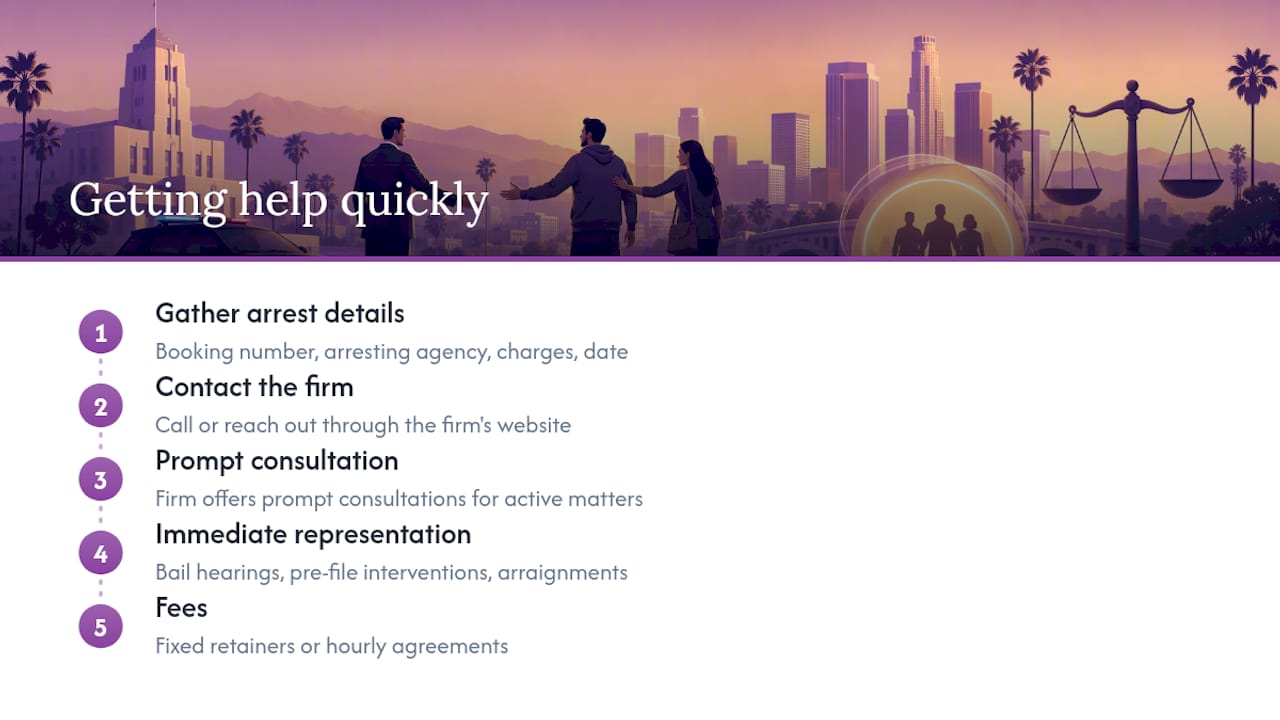
Rubinlawpc provides immediate criminal defense representation across Los Angeles County, including bail hearings, pre-file interventions, and arraignment appearances. The firm's attorneys know the local courtrooms, the prosecutors, and the magistrates who set bail, which means they can make targeted, fact-specific arguments rather than generic ones. That local knowledge is what separates a bail hearing that results in OR release from one that results in the full scheduled amount.
To get started, contact Rubin Law, P.C. with your booking number, the arresting agency, the charges, and the date of arrest. The firm offers prompt consultations for clients facing active criminal matters. Fees are structured as fixed retainers or hourly agreements depending on the case. Call or reach out through the firm's website to speak with an attorney today.
This article provides general legal information about the Los Angeles bail schedule and is not legal advice. Bail rules, amounts, and eligibility criteria change; confirm current figures and your specific situation with a qualified California criminal defense attorney or the Los Angeles Superior Court directly.
Useful sources
- NATION’S LARGEST TRIAL COURT UNVEILS SAFE AND FAIR PRE-ARRAIGNMENT RELEASE PROTOCOLS FOR NON-VIOLENT, NON-SERIOUS FELONIES AND MISDEMEANORS
- 2026 MISDEMEANOR BAIL SCHEDULE
- 2026 FELONY BAIL SCHEDULE
- BAIL SCHEDULE for INFRACTIONS and MISDEMEANORS
- FELONY BAIL SCHEDULE
- Los Angeles Superior Court — official website
- Bail and Bail Hearings California — How to Get Released | Rubin Law, P.C.
Penal Code sections referenced in the schedules:
| Statute | Purpose |
|---|---|
| Penal Code § 1269b | Authorizes the bail schedule and pre-arraignment release by magistrate |
| Penal Code § 1275 | Sets factors for judicial bail determination (public safety, prior record, appearance probability) |
| Penal Code § 815a | Governs magistrate authority at first appearance |
| Penal Code § 1270.1 | Lists offenses ineligible for non-financial pre-arraignment release |
Always open the PDF directly from lacourt.org or the court's Azure storage link and check the effective date printed on the cover page. If the court has issued an interim amendment or emergency schedule, a notice will appear in the court's news releases section at lacourt.org.