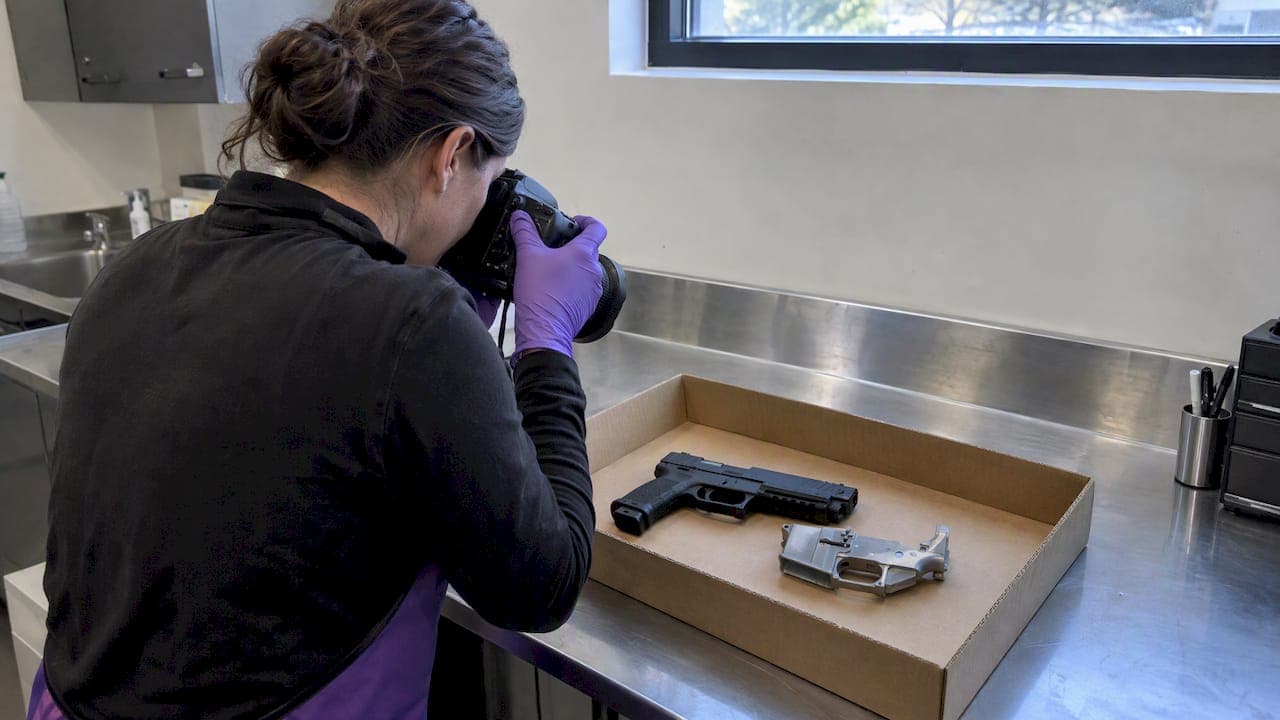
Yes, under current California law, many unfinished receivers, precursor parts, conversion devices, and even certain digital manufacturing files can lead to criminal charges, and federal exposure is also real. New statutes effective in 2026 expanded both criminal penalties and civil liability for this conduct. If you are under investigation or have already been contacted by law enforcement, say nothing beyond identifying yourself, ask for a lawyer, and preserve any devices or files rather than deleting them.
TL;DR:
- Each unserialized firearm or precursor part found in a search can lead to multiple separate criminal charges, increasing penalties with multiple items.
- Digital files for 3D printing or CNC milling firearm parts can now trigger liability under expanded California laws starting in 2026.
- Federal penalties for unlicensed firearm dealing or manufacturing devices, such as converting a semi-automatic to automatic, can carry maximum prison sentences up to five years per count.
- Cases often escalate from simple possession to federal investigation when investigators link online sales, manufacturing equipment, and multiple small transactions.
- Early legal intervention, including preserving evidence and seeking suppression, can significantly influence whether charges are reduced or cases are dismissed.
Table of Contents
- What Counts as a Ghost Gun or Privately Made Firearm in California
- State and Federal Charges and Penalties You Could Face
- How These Cases Usually Start: Evidence and Investigation Patterns
- Defenses and Legal Options in Ghost Gun Cases
- What to Do Right After a Search, Arrest, or Ghost Gun Investigation
- Civil Lawsuits and New Liability Under AB 1263
- State Charges vs. Federal Indictments: Why Cases Escalate
- Why Early Representation Changes the Outcome
- How Rubin Law, P.C. Can Help With a Ghost Gun or Federal Firearms Matter
- FAQ
- Sources
What Counts as a Ghost Gun or Privately Made Firearm in California
California law does not use the term "ghost gun" as a formal legal definition, but the statutes reach a wide range of homemade and unserialized firearms. A privately made firearm (PMF) is a firearm manufactured or assembled by someone other than a licensed manufacturer, typically without a serial number. The law also regulates firearm precursor parts, which include unfinished frames and receivers that can readily be converted into a functioning firearm.
California Penal Code §29180 governs the assembly of firearms from precursor parts and requires serialization and background-check procedures before a PMF can legally exist. The statute treats each firearm found in violation as its own separate offense, a detail that matters enormously once multiple items are seized in a single search.
Recent amendments, summarized in the California Ghost Gun Laws Reference Guide published by the Attorney General's office, expanded the regulated category to include certain digital firearm manufacturing code, meaning the files used to 3D-print or CNC-mill a receiver can themselves trigger liability for distribution. The guide also clarifies obligations for firearm industry members, a term covering manufacturers, sellers, and some online platforms.
Items that commonly draw scrutiny under these definitions include:
- An unfinished AR-15 style receiver purchased as a kit without serialization.
- A 3D-printed frame or receiver produced from downloaded code.
- A CNC-milled frame finished at home or in a small shop.
- A conversion device, such as a switch that turns a semiautomatic pistol into a fully automatic weapon.
State and Federal Charges and Penalties You Could Face
California penalties for unlawful possession or assembly of a privately made firearm range from a misdemeanor to a felony, depending on the specific conduct, the type of firearm involved, and the person's criminal history. Under Penal Code §29180, certain handgun-related violations carry up to one year in county jail or fines up to $1,000, but because each firearm is a distinct offense, a search that turns up five unserialized frames can produce five separate counts rather than one.
AB 1263, effective January 1, 2026, added new provisions including Penal Code §29186, which makes it a misdemeanor to cause or facilitate the unlawful manufacture of a firearm. The same legislative package attached a 10-year firearm possession prohibition to certain convictions, a consequence that reaches well beyond the original criminal sentence and can affect someone's ability to legally own any firearm for a decade. Our page on California gun laws walks through how these prohibitions interact with other firearm statutes.

Federal exposure often carries a higher ceiling than the state charge that triggers it. The ATF confirms that unlicensed dealing in firearms can carry a statutory maximum of up to five years in prison per count, and machine-gun or National Firearms Act related counts, which frequently attach when a conversion device is found, can add decades when stacked with other charges.
Several factors push sentencing exposure higher:
- A prior felony conviction can add sentencing enhancements under both state and federal guidelines.
- Multiple firearms recovered in one case typically become multiple separate counts rather than one combined charge.
- Evidence of sales or distribution, rather than simple possession, invites federal attention and conspiracy charges.
Our overview of federal weapons charges in California explains how ATF involvement changes the calculus once a case crosses from a local possession matter into a federal firearms investigation.
How These Cases Usually Start: Evidence and Investigation Patterns
Ghost gun prosecutions rarely begin with a random stop. They typically build from a pattern of evidence that investigators piece together over weeks or months.
- Possession of an unfinished receiver or precursor part found during an unrelated traffic stop, probation search, or search warrant execution.
- Online marketplace activity, where task forces monitor forums and social media for the sale of kits, files, or completed unserialized firearms.
- Undercover purchases, in which agents buy a PMF or conversion device directly from a seller to build a paper trail for charges.
- Possession of manufacturing equipment, such as a 3D printer loaded with receiver files or a CNC machine with matching tool paths, which supports an inference of ongoing production rather than a single isolated item.
- Aggregation across incidents, where a regional or state task force links multiple small transactions into one larger case, often the trigger that converts a state matter into a federal indictment.
A single unfinished receiver found in a closet looks very different to a prosecutor than the same receiver found alongside a 3D printer, digital files, and shipping records suggesting sales. The latter fact pattern is what tends to escalate a case from a misdemeanor charge into bundled felony counts or a federal referral.
Defenses and Legal Options in Ghost Gun Cases
A charge is not a conviction, and ghost gun cases often turn on technical and constitutional questions that a skilled criminal defense strategies attorney can exploit. Several defense angles come up repeatedly:
- Lack of possession or control, particularly when a precursor part was found in a shared residence, vehicle, or storage unit accessible to multiple people.
- Lack of knowledge, since several statutes require the prosecution to prove the person knew the item met the legal definition of a firearm or precursor part.
- Chain-of-custody and forensic challenges, questioning whether the seized item actually meets the statutory threshold for a "firearm" or whether lab testing was handled correctly.
- Search and seizure suppression motions, challenging whether the warrant, consent, or probable cause behind the search was legally sound.
Procedurally, defense counsel generally has several paths available depending on the facts: pursuing diversion where eligible, negotiating a plea to a lesser charge, or, in cases with pending federal exposure, evaluating venue strategy to understand whether a state resolution might head off a federal referral. Prefile intervention, raised before formal charges are filed, can sometimes keep a case out of the system entirely. Our felony diversion page describes how that process works in Los Angeles County.
Whether a part counts as a regulated precursor part is a factual and legal question, not a marketing claim.*
Defense counsel typically evaluates the strength of the evidence, the realistic risk that a case escalates to federal court, the client's prior record, and whether the client's priority is avoiding a conviction altogether or minimizing exposure through a negotiated resolution.
What to Do Right After a Search, Arrest, or Ghost Gun Investigation
What you do in the first hours after contact with law enforcement can shape the entire case.
- Stay silent beyond basic identification. Anything said after that point can be used against you, and volunteering explanations rarely helps.
- State clearly that you want a lawyer and stop answering questions until one is present.
- Do not consent to a search of your phone, computer, vehicle, or residence beyond what officers already have a warrant for.
- Preserve rather than delete any digital files, messages, or devices connected to the investigation; deleting evidence can create a separate obstruction problem.
- Write down what happened as soon as possible: officer names, badge numbers, warrant details, and the time and sequence of events.
Pro Tip: Photograph the warrant itself if officers allow it, since the scope of a warrant often becomes the center of a later suppression motion.
Contacting an attorney quickly matters because early involvement can influence what evidence gets preserved for a suppression motion and shape negotiations before the prosecution's position hardens.
Civil Lawsuits and New Liability Under AB 1263
Criminal charges are not the only risk. AB 1263 and related 2025 to 2026 amendments created and expanded civil causes of action tied to ghost guns, separate from any criminal case. The Information Bulletin 2026-DLE-02 describes new civil prohibitions against distributing digital firearm manufacturing code or otherwise facilitating unlawful manufacture, and these claims can be brought independently of a criminal prosecution.
The Firearm Industry Responsibility Act imposes duties on firearm industry members, a category that can include small sellers and online platforms, not just large manufacturers.
- Distributing digital files used to manufacture firearms can expose a person or business to civil claims, not only criminal charges.
- Failing to meet consumer-notice or age-verification duties under FIRA can itself support a lawsuit.
- Civil remedies can include injunctive relief and, in some cases, destruction or confiscation of equipment, on top of any criminal penalty.
For hobbyists and small-scale sellers, this means the legal risk does not end even if a prosecutor declines to file criminal charges.
State Charges vs. Federal Indictments: Why Cases Escalate
Not every ghost gun case stays local. ATF task forces and federal prosecutors tend to step in once a case shows signs of organized distribution rather than a single instance of possession.
- Federal agencies often aggregate evidence from multiple local incidents, online sales, and undercover buys before bringing a single, larger indictment.
- A federal press release describing an unlicensed firearms business out of Los Angeles resulted in a multi-year federal prison sentence, illustrating how an unlicensed dealing pattern draws sustained federal attention rather than a one-time citation.
- Federal prosecutors generally have more resources for extended investigations and tend to pursue conspiracy or trafficking theories when multiple transactions appear in the evidence.
- Plea dynamics differ sharply between the two systems: federal sentencing guidelines and mandatory minimums can leave far less room for negotiation than a comparable state charge.
What begins as a single possession arrest in state court can become a multi-defendant federal conspiracy case once investigators connect it to a broader pattern, which is why defense counsel evaluates federal risk from the earliest possible stage.
Why Early Representation Changes the Outcome
Ghost gun cases move fast once an unfinished receiver or conversion device surfaces in a search, and the gap between a misdemeanor resolution and a bundled federal indictment often comes down to decisions made in the first days. Courtroom familiarity with how Los Angeles County prosecutors and judges treat firearm precursor cases shapes which motions get filed early and which plea positions are realistic. Clients contacting us at the investigation stage, before any charge is filed, generally have more options than those who wait.
— Jake
How Rubin Law, P.C. Can Help With a Ghost Gun or Federal Firearms Matter
If you are facing a ghost gun investigation, a Penal Code §29180 charge, or a federal firearms referral, we can provide legal assistance including motions practice, suppression challenges, plea negotiation, and, where appropriate, diversion or prefile intervention. Because these cases can shift from a state misdemeanor into a federal case with much higher stakes, we focus on building a defense strategy before charges harden, not after.

Everything you share with us stays confidential, and we can begin working on evidence preservation and search-and-seizure issues promptly. If you are under investigation or have already been arrested, reach out through our criminal defense page to set up a consultation and find out what your realistic options are.
This article is general information, not a substitute for advice from a qualified lawyer. Consult a qualified legal professional about your own circumstances before acting on anything here.
FAQ
What happens if I get pulled over with a ghost gun?
An officer who finds an unserialized firearm or precursor part during a stop can arrest you on the spot, and the item is typically seized as evidence. Whether the stop and any search that followed were lawful often becomes the central issue in the defense, since an improper search can lead to suppression of the firearm as evidence.
How long is a sentence for a ghost gun charge?
Sentencing varies widely depending on whether the case is charged as a state misdemeanor, a state felony, or referred to federal court. Under Penal Code §29180, some violations carry up to one year in county jail, while federal unlicensed dealing counts can carry a statutory maximum of up to five years per count, with machine-gun related counts adding far more.
What happens if you get caught with a gun with no serial number?
Possessing a firearm without a serial number can be charged under California's precursor parts and assembly statutes, and each unserialized firearm found is typically treated as a separate offense. A conviction for certain related offenses can also trigger a 10-year firearm possession prohibition under recent amendments described in the Attorney General's reference guide.
How much jail time can you get for a gun charge in California?
Jail or prison time depends heavily on whether the charge is a misdemeanor or felony, how many firearms are involved, and whether the case escalates to federal court. Because each firearm can count as its own offense, a case involving several unserialized frames or a conversion device can carry far more exposure than a single possession charge, and our felony versus misdemeanor overview explains how that distinction is drawn.
Sources
- ATF — Privately Made Firearms (Ghost Guns)
- California Ghost Gun Laws Reference Guide — Attorney General (2025)
- California Penal Code §29180 — Assembly of Firearms