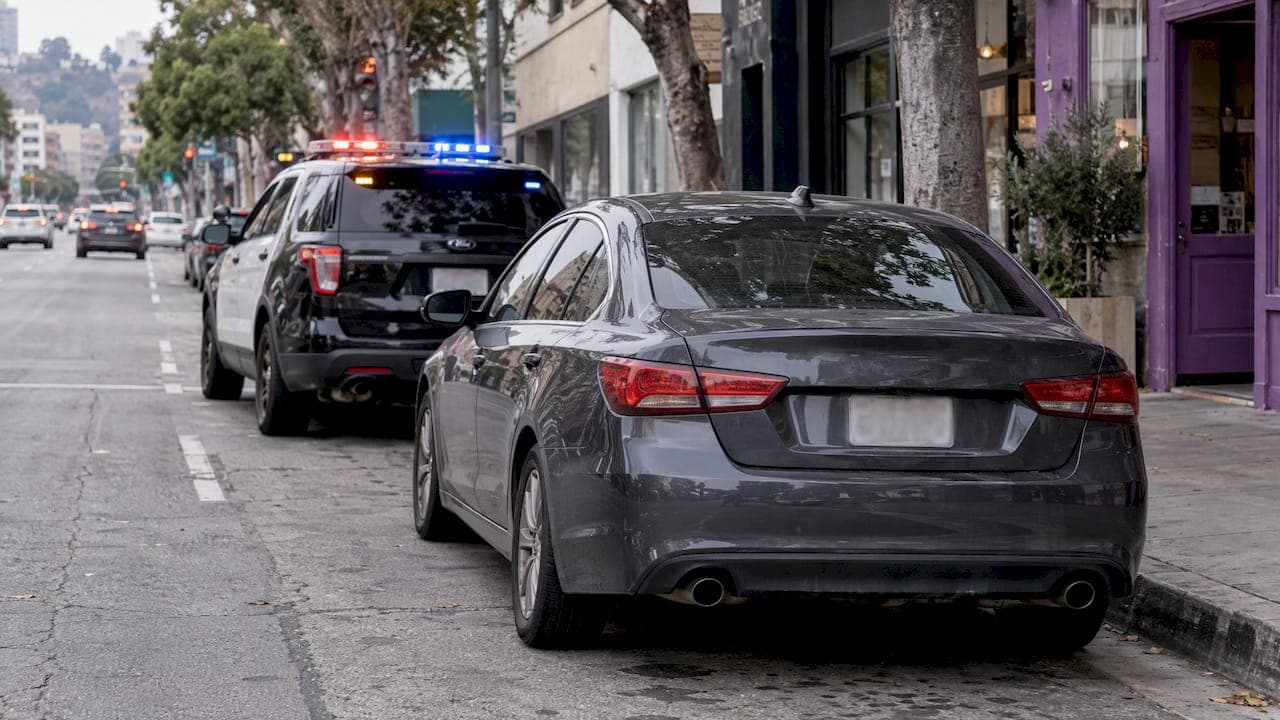
In California, a detention is a temporary stop in which an officer investigates suspected criminal activity, and it requires reasonable suspicion. An arrest is taking you into custody, and it requires probable cause. The line between the two decides what an officer may do, how long it may last, and whether evidence found along the way can be used against you later.
This guide explains both, shows how to tell which one you are in, and covers handcuffs, pat-downs, ID and the point where a stop turns into an arrest. It is general information, not advice on your case. If you were stopped, cited or booked, a criminal defense attorney should look at the specific facts.
TL;DR
- A detention needs reasonable suspicion: specific, articulable facts, not a hunch. An arrest needs probable cause.
- A detention must be limited in scope, intensity and duration. If the suspicion is explained away, the officer must let you go.
- A pat-down is allowed only during a lawful detention, and only when the officer can point to facts showing you are armed and dangerous.
- Handcuffing and moving someone can turn a detention into an arrest, and an arrest without probable cause is unlawful.
- An unlawful detention or arrest can lead to suppression of evidence, so the details of the stop matter for your defense.
Table of Contents
- The short answer: what separates a detention from an arrest
- What "reasonable suspicion" means
- What "probable cause" means
- How to tell whether you are being detained
- Terry stops and pat-downs
- How long can police detain you?
- Handcuffs, movement and the point where a stop becomes an arrest
- Do you have to show ID?
- When a detention is unlawful, and why it matters to your case
- Arrest and release: what Penal Code 849.5 says
- Preserve what happened
- Our perspective: the stop is where the case is often won
- If you were detained or arrested in Los Angeles County
- FAQ
- Sources
The short answer: what separates a detention from an arrest
California peace officers train on three levels of contact. The first is a consensual encounter, where you are free to walk away. The second is a detention, which the state's Commission on POST training materials describe as an assertion of authority that is less than an arrest and more substantial than a consensual encounter. The third is an arrest.
The same training materials point to Penal Code section 834, which defines an arrest as taking a person into custody in a case and in the manner authorized by law. That wording implies full control over you. In a detention, the officer holds you only briefly, to confirm or dispel a suspicion.
| Detention | Arrest | |
|---|---|---|
| Legal standard | Reasonable suspicion | Probable cause |
| Purpose | Investigate suspected criminal activity | Take you into custody |
| Duration | Limited, as brief as the purpose allows | Custody, followed by booking or release |
| Control over you | Limited in scope and intensity | Full control |
| Ends when | Suspicion is dispelled or becomes probable cause | Release, citation or court process |
What "reasonable suspicion" means
Reasonable suspicion is the standard for a detention. Under the POST workbook, it means specific, articulable facts that criminal activity is afoot and that the person stopped is involved. The same material says a hunch or instinct is not enough.
The San Francisco Police Department's general order on investigative detentions adds that a detention must be objectively reasonable based on the totality of the circumstances. That is meant to prevent arbitrary or hunch-based stops.
In practice, officers often cite things like a match to a suspect description, presence near a recent crime, or behavior they say fits a known pattern. Each of those can be tested later. Is the description specific, or does it fit half the neighborhood? Was the crime nearby in time? Does the officer's report give facts, or only labels such as "furtive movements"?

What "probable cause" means
Probable cause is higher. It means facts that would lead a reasonable person to believe a crime was committed and that you committed it. The POST workbook treats it as the standard for arrest, and the SFPD order says the same.
California law also limits when an officer can arrest without a warrant. Penal Code section 836 allows an arrest under a warrant, or without one when the officer has probable cause to believe:
- you committed a public offense in the officer's presence,
- you committed a felony, even outside the officer's presence, or
- a felony occurred and you are the person responsible.
If an arrest does not fit one of those routes and there is no warrant, the arrest itself may be open to challenge.
How to tell whether you are being detained
Many people are unsure whether they are free to go. According to the POST materials, you are detained when an officer's words or conduct would make a reasonable person feel they cannot leave or end the encounter. Examples include blocking your path, keeping your license, ordering you to stop, or turning on emergency lights behind your parked car.
The practical move is to ask calmly: "Am I being detained, or am I free to leave?" If the officer says you are free to go, walk away calmly. If you are being detained, you know the officer needs reasonable suspicion, and you can stay silent beyond basic answers and avoid consenting to searches.
An arrest is usually clearer. The officer says you are under arrest, handcuffs you, and takes you to a vehicle or station. But words are not required. Conduct can make a stop an arrest, which is covered below.
Terry stops and pat-downs
A "Terry stop" is the common name for an investigative detention, after a U.S. Supreme Court case. In California it is a detention based on reasonable suspicion. It is not an arrest, but it does allow limited steps the officer could not take in a casual conversation.
The officer may not frisk everyone they stop. Under the POST workbook, a pat search is allowed only when the detention is lawful and the officer can state specific, articulable facts supporting a belief that you are armed and dangerous. The SFPD general order states the same two requirements.
That has two consequences for a defense:
- If the detention was unlawful, the frisk was too. Anything found is vulnerable to a motion to suppress.
- If the detention was lawful but the frisk lacked facts, the frisk is still challengeable. "Officer safety" alone does not justify a pat-down. The officer needs the facts.
This is where many drug and weapons cases begin. A pat-down that turns up a small bag, or a gun in a waistband, may come down to whether the officer could explain, in specific terms, why they believed you were armed and dangerous.
How long can police detain you?
California has no fixed number of minutes. The POST workbook says a detention is limited in scope, intensity and duration. The stop can last only as long as needed to confirm or dispel the suspicion.
That matters most in two situations:
- The suspicion is cleared up. The POST materials say that if the suspicious circumstances are satisfactorily explained, the officer must release you.
- The officer drags the stop out. Waiting for a drug-sniffing dog, running unrelated checks, or holding you while hoping for something to turn up can stretch a detention beyond its purpose.
According to the SFPD order, an unreasonably long duration or unnecessary restraints can turn a detention into a de facto arrest. If that happens without probable cause, the arrest is unlawful.
Handcuffs, movement and the point where a stop becomes an arrest
People often assume handcuffs equal arrest. The law is more nuanced: restraints can be used in some detentions when circumstances call for them, but unnecessary restraints weigh toward arrest.
In People v. Campbell (1981), the court found that handcuffing the suspect and moving him for further investigation went beyond a reasonable detention under the circumstances and amounted to an arrest. Factors that push a stop toward arrest include:
- handcuffs without a safety reason,
- moving you to another location, such as a patrol car or station,
- a long hold,
- multiple officers with weapons drawn when nothing suggests danger, and
- taking your ID or keys and holding them while the officer investigates.
The SFPD order explains that when the scope of a detention is exceeded, the encounter changes its legal nature into an arrest, and that requires probable cause. If officers lacked probable cause at that moment, the arrest is unlawful and what followed may be suppressed.
Do you have to show ID?
The POST workbook says there is no general requirement to show identification during a detention unless specific circumstances apply. Some situations do carry their own rules. If you are driving, you are generally expected to produce a license when stopped for a traffic violation, and certain other contexts impose separate duties.
The safest approach is to stay calm, say you do not consent to searches, and avoid arguing about the law roadside. Courtroom is the place to litigate whether the stop was lawful. Refusing a search is not resisting. Pulling away, running or physically interfering can create new charges even if the original stop was improper.
When a detention is unlawful, and why it matters to your case
A stop is on shaky ground when it starts without reasonable suspicion, runs longer than its purpose, or turns into an arrest without probable cause. The POST materials note that improperly elevating a consensual encounter into a detention can violate the Fourth Amendment and result in suppression of evidence.
Suppression is often the center of a criminal case. If the stop or search was unlawful, the prosecution may lose the evidence it depends on: drugs, a firearm, a phone, a statement. Without that evidence, charges can be reduced or dismissed. Our page on California criminal laws A-Z explains how the charges that start with a stop are defined.
One related topic is the pretext stop, where an officer uses a minor violation to investigate something else. We explain how those work in our guide to pretextual stops in California.
If an officer held you in a way that looks like confinement beyond what the law allowed, a separate statute may apply to private actors, which we cover under false imprisonment in California. Civil claims for false arrest against police are a different matter, and a civil rights attorney handles those.

Arrest and release: what Penal Code 849.5 says
Being released after an arrest does not always mean the arrest disappears. But Penal Code section 849.5 says that when a person is arrested and released and no accusatory pleading is filed, the arrest is thereafter deemed a detention only. That is a meaningful protection when no charges are filed.
The arrest record may still exist, and a record can cause trouble with jobs and housing. Our guide to sealing arrest records under PC 851.8 covers how a person who was arrested but not convicted can ask to have the record sealed.
If you were taken into custody, the next steps are different from after a detention. Our complete guide on what happens after an arrest in California walks through booking, release, and the first court dates.
Preserve what happened
Details fade fast, and the reports are written by the officers. Write down what you remember as soon as you can: the time, the place, what the officer said was the reason, whether you were told you could leave, whether you were frisked, handcuffed or moved, and who else was there. Note any cameras nearby, such as businesses or doorbells, because footage is often overwritten quickly.
Recording is also lawful in many situations, and there are rules about preserving it. This guide to recording police in California explains how to keep footage under SB 411. Never interfere with the officer while recording, and keep your distance.
Our perspective: the stop is where the case is often won
We appear in Los Angeles County courtrooms often, and we see the same pattern. Clients tell us about the charge, the drugs or the gun. We start earlier, with the first ten minutes of the encounter. Why was the person stopped? What facts did the officer have at that moment? When did a detention become an arrest, and was there probable cause by then?
Those questions are why we pay attention to how local officers write reports, how prosecutors respond to suppression motions, and how particular judges handle them. A report that says "reasonable suspicion" without facts is a different case than one with a clear description and timeline. Constitutional challenges to the stop, the frisk or the length of the hold are central to how we defend drug, DUI, weapons and other cases.
The second thing we tell clients is not to try to win the argument on the street. Be polite, stay silent beyond identifying yourself where required, do not consent to searches, and call a lawyer. What you say at the roadside is easy for a prosecutor to use and hard for you to take back.
— Jake
If you were detained or arrested in Los Angeles County
Our firm defends clients facing drug, DUI, domestic violence, sex offense, violent crime and federal charges, and we raise stop-and-search issues from the start. We can also step in before charges are filed through pre-file intervention, when you know you are under investigation. See our criminal defense practice areas or contact us through Rubin Law, P.C. to talk about what happened in your stop.
FAQ
Are arrest and detention the same thing in California?
No. A detention is a limited stop that requires reasonable suspicion, and an arrest is taking someone into custody that requires probable cause. A detention can become an arrest if the officer goes beyond what the suspicion justifies.
Can police handcuff you during a detention?
Sometimes, but handcuffs and moving you to another place can push a detention into an arrest. In People v. Campbell, handcuffing and moving the suspect for further investigation exceeded a reasonable detention and was treated as an arrest. Whether restraints were justified depends on the circumstances.
How long can you be detained without charges?
There is no set time. A detention is limited in scope, intensity and duration, and the officer must release you if the suspicious circumstances are explained. A stop that lasts longer than its purpose requires can become a de facto arrest.
Do you have to show ID when detained in California?
There is no general requirement to show identification during a detention unless specific circumstances apply, according to POST training materials. Drivers are in a different position during traffic stops. If you are unsure of your duties in a particular situation, ask an attorney.
Can a stop be challenged after the fact?
Yes. A defense attorney can file a motion to suppress evidence from a stop, frisk or arrest that lacked reasonable suspicion or probable cause. If the court grants it, the prosecution may be unable to proceed with the evidence it relied on.
Sources
- Commission on POST, Learning Domain 15 workbook: Laws of Arrest and detentions
- California Penal Code, sections 834 to 849.5 (Legislative Information)
- San Francisco Police Department, General Order 5.03 Investigative Detentions
- People v. Campbell (1981), CourtListener