
Carjacking under California Penal Code 215 is the felonious taking of a vehicle from someone's immediate presence against their will by force or fear, with intent to permanently or temporarily deprive them of it. It's always charged as a felony carrying three, five, or nine years in state prison before enhancements. If you're facing this charge, the first move isn't explaining yourself to police. It's staying silent and calling a defense attorney who handles PC 215 cases before you say another word.
TL;DR:
- The prosecution must prove every element beyond a reasonable doubt, including that the defendant formed intent only at the moment force or fear was used.
- Valid defenses include lack of force or fear, honest belief of ownership, consent, or that intent was formed only after the act of force, which can significantly lower potential penalties.
- Sentence range for a carjacking conviction is three, five, or nine years, with enhancements for firearm use and a mandatory strike under California law, drastically increasing long-term consequences.
- Early legal intervention can prevent evidence from being admitted, improve chances of plea deals, and avoid a strike classification that impacts future charges and immigration status.
- Reclassification to grand theft auto is often possible when force or fear cannot be proven, representing a key leverage point for reducing charges and potential prison time.
Table of Contents
- What Prosecutors Must Prove for a PC 215 Conviction
- Defenses That Target Specific Elements of PC 215
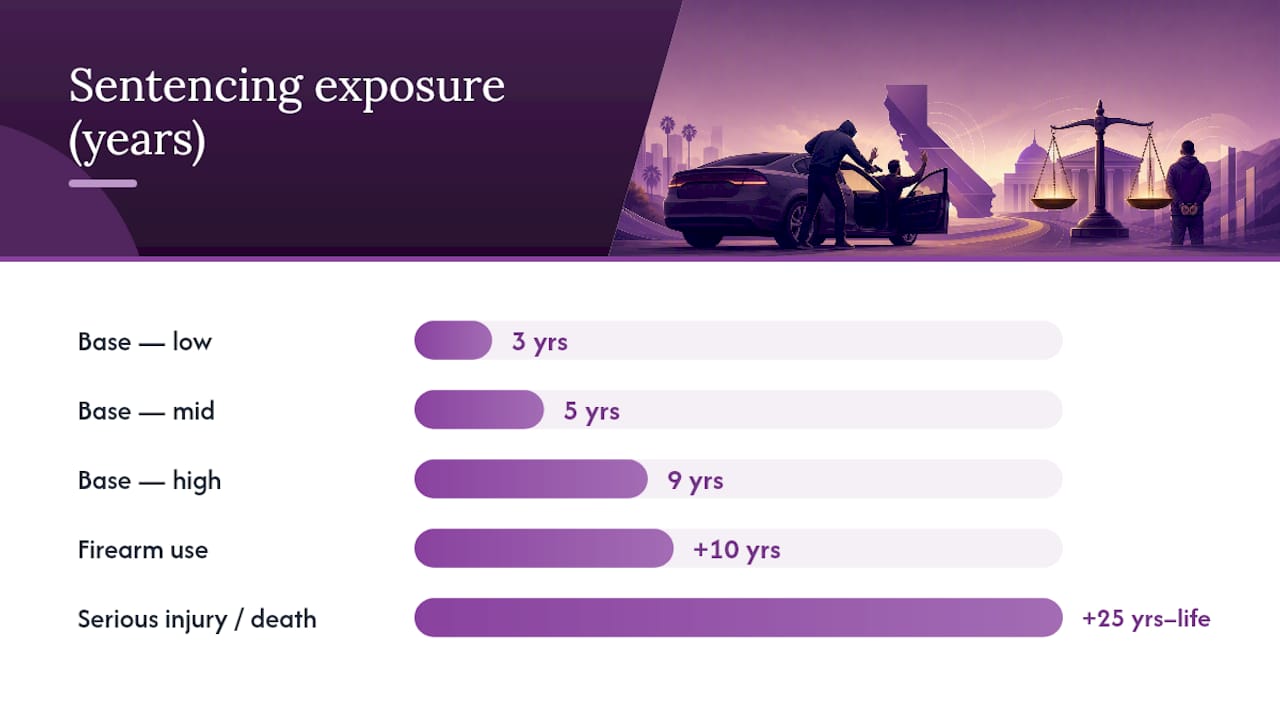
- Sentencing Exposure: Base Terms, Enhancements, and Strike Consequences
- Carjacking vs. Robbery vs. Grand Theft Auto
- Your First 48 to 72 Hours After Arrest
- How Experienced Defense Teams Approach PC 215 Cases
- Why Early Counsel Changes the Outcome
- Get Legal Representation for a Carjacking Charge
- Primary Sources and Legal References
- Sources
- FAQ
What Prosecutors Must Prove for a PC 215 Conviction
Carjacking cases rise or fall on five specific elements, and prosecutors have to nail every one of them beyond a reasonable doubt. Miss one, and the charge collapses into something else entirely, usually a lesser offense with far less prison time attached.
According to CALCRIM No. 1650, the jury instruction California courts use to explain carjacking to juries, the prosecution must establish:
- The defendant took a vehicle that wasn't their own
- The vehicle was taken from another person's possession or immediate presence
- The taking happened against that person's will
- The defendant used force or fear to accomplish the taking or to keep the person from resisting
- The defendant intended, when using that force or fear, to deprive the owner of the vehicle either temporarily or permanently
Two of these phrases do most of the legal heavy lifting: "immediate presence" and intent timing. Courts define immediate presence broadly. You don't need to be sitting in the driver's seat for a carjacking to occur. Case law including People v. Hayes and People v. Hoard has upheld convictions where a defendant grabbed keys from someone standing several feet from the car, because the vehicle was still within the victim's control at the moment force was used, per the same CALCRIM commentary.
Intent timing matters just as much. The law requires that intent to deprive the victim of the vehicle exist at the moment force or fear is applied, not before and not after. If someone forms the idea to take a car only after a physical altercation that started for unrelated reasons, the carjacking element arguably never materializes. This single distinction, buried in a jury instruction most defendants never read, is often the difference between a strike offense and a much less severe outcome.
"Beyond a reasonable doubt" is the highest evidentiary standard in American law, and it applies to every one of these five elements individually. A prosecutor can have overwhelming evidence on force and fear and still lose the case entirely if the timing of intent is genuinely ambiguous. That's exactly where defense strategy tends to concentrate.
Defenses That Target Specific Elements of PC 215
Every viable defense to a carjacking charge attacks one of the five elements above. Understanding which element is weakest in your case is the starting point for any real strategy, not a generic "fight the charges" approach.
- No force or fear. If the vehicle was taken without any use or threat of force, the charge should legally be grand theft auto under Vehicle Code §10851, not carjacking. This distinction alone can cut potential prison exposure by years.
- Consent. If the vehicle's possessor voluntarily handed over the keys or agreed to the taking, the "against their will" element fails outright. This comes up more than people expect in disputes involving rideshare drivers, rental agreements, or informal loan arrangements between acquaintances.
- Claim of right or ownership dispute. Someone who genuinely (even if mistakenly) believes the vehicle is legally theirs, perhaps in a joint-ownership dispute or after a contested repossession, may lack the criminal intent PC 215 requires.
- Timing of intent formed after the force. As covered above, if the decision to take the car occurred only after an altercation triggered by something else entirely, defense counsel can argue the carjacking element never attached. Timeline reconstruction and witness statements are the tools that make or break this argument.
- Duress or necessity. These defenses require an immediate threat of death or serious injury that left the defendant no reasonable alternative. Courts apply this standard narrowly, and it rarely succeeds without very specific factual support.
- Misidentification. Eyewitness identifications made under stress, at night, or during a fast-moving encounter are notoriously unreliable. Cross-examining identification procedures, and challenging suggestive photo lineups or show-ups, can undercut the prosecution's entire evidentiary foundation.
- Negotiated resolution. When the facts are difficult but not hopeless, plea negotiations, reduction to a lesser charge, or diversion eligibility can produce a far better outcome than rolling the dice at trial.
Pro Tip: Don't assume the police report's characterization of "immediate presence" or "force" is accurate or final. Officers often write reports that stretch the legal definitions to fit the arrest they already made. A defense attorney who pulls the underlying witness statements frequently finds gaps between what's alleged and what can actually be proven.
Sentencing Exposure: Base Terms, Enhancements, and Strike Consequences
A carjacking conviction under Penal Code §215 carries a base state prison sentence of three, five, or nine years. Judges choose within that range based on factors like the defendant's criminal history, the presence of a weapon, and how the incident unfolded. None of it is discretionary in the sense of avoiding prison. Carjacking has no probation-only outcome under the statute.
Enhancements are where the real exposure lives:
- Personal use of a firearm can add years under separate firearm-use statutes
- Discharging a firearm, or causing great bodily injury, triggers additional consecutive time
- California's "10-20-life" firearm enhancement scheme can apply in cases involving a gun, adding ten years for use, twenty for discharge, and twenty-five to life if someone is seriously injured or killed
- A carjacking conviction counts as a serious felony and a strike under California's Three Strikes law, meaning a second qualifying felony down the road can double the sentence, and a third can trigger 25 years to life
The CHP's 2025 Vehicle Theft Fact Sheet tracks statewide vehicle theft and recovery data by county, underscoring how seriously California treats vehicle crimes generally and why carjacking, the most aggressive form of it, draws such heavy statutory penalties.
Strike status follows a person for life. It affects future sentencing on unrelated charges, and it can trigger immigration consequences for noncitizens regardless of how the case ultimately resolves. This is precisely why plea negotiations and diversion eligibility matter so much before a case reaches trial. An attorney who can shift the charge away from PC 215 entirely, or negotiate a resolution that avoids strike classification, changes the trajectory of a client's entire life, not just the immediate sentence.
Carjacking vs. Robbery vs. Grand Theft Auto
Prosecutors have real charging discretion here, and which statute they choose shapes everything downstream.
- Robbery (PC 211) covers taking any property, not just a vehicle, from a person by force or fear. Carjacking is essentially a specialized subset of robbery that applies specifically to motor vehicles and carries its own sentencing scheme.
- Grand theft auto (Vehicle Code §10851) applies when a vehicle is taken without the use of force or fear against a person, such as a car stolen from a driveway or hot-wired in a parking lot. It carries substantially less prison exposure than carjacking.
- Kidnapping during carjacking (PC 209.5) can be charged when the victim is moved a substantial distance during the incident, layering an additional serious felony on top of the carjacking count.
Reclassifying a charge from carjacking down to grand theft auto, when the facts support it, can be the single biggest lever in a defense strategy. The gap in exposure between the two statutes is significant, and it often comes down to whether force or fear can actually be proven against the person, not just the property.
Your First 48 to 72 Hours After Arrest
What you do in the first three days after an arrest shapes the rest of the case, sometimes irreversibly.
- Invoke your right to remain silent and ask for an attorney immediately. Do this clearly and in words, not by staying quiet and hoping officers get the hint. Anything said afterward, even in casual conversation with an officer, can be used against you.
- Refuse consent to any search of your phone, home, or vehicle unless officers have a warrant. Write down the exact sequence of events while it's fresh: who was present, what time things happened, and where.
- Get contact information for any witnesses and the police report or incident number. These details are far harder to reconstruct weeks later.
- Preserve phone records, text messages, and any dashcam or surveillance footage you have access to before it's automatically deleted or overwritten.
- Understand the arraignment and bail timeline. Bail amounts on carjacking charges tend to run high given the strike classification, and costs for a bond can add up quickly, as outlined in this breakdown of California bail bond pricing. An attorney engaged early can sometimes pursue prefile intervention, negotiating with prosecutors before formal charges are even filed, which is often the best window for avoiding a felony filing altogether.
How Experienced Defense Teams Approach PC 215 Cases
Carjacking cases are won or lost on evidence that never should have made it into the courtroom in the first place. Suppression motions targeting improper searches, coercive interrogations, or suggestive lineup procedures can strip the prosecution of its strongest evidence before trial even starts, which shifts negotiating leverage dramatically.
The strongest carjacking defenses rarely come from disputing that something happened. They come from proving the prosecution can't establish one specific element, usually force, fear, or the timing of intent, to the standard the law actually requires. That's a fact-intensive fight, and it has to start the moment someone is arrested, not after an information is filed.
Frequent courtroom appearances and familiarity with how local judges and prosecutors evaluate these cases inform when to push for a suppression hearing, when diversion or prefile intervention is realistic, and when a negotiated plea genuinely serves the client better than a trial gamble. Rubin Law's PC 215 resource walks through how these tactics apply case by case.
Why Early Counsel Changes the Outcome

Every day that passes after an arrest without an attorney is a day evidence isn't being preserved and constitutional issues aren't being flagged. Getting counsel involved before charges are even filed opens doors that close fast: suppression arguments, diversion eligibility, and plea leverage all shrink the longer a case sits unmanaged.
There's no substitute for someone who knows the local courts pushing back immediately. Silence, documentation, and a lawyer on day one are the three things that actually move a case toward a better outcome.
— Jake
Get Legal Representation for a Carjacking Charge
A carjacking charge doesn't wait for you to figure out your next move, and neither should your defense. The approach is built around frequent courtroom appearances in Los Angeles County, which means direct familiarity with how local judges and prosecutors actually handle PC 215 cases rather than generic playbook tactics.

An initial consultation typically starts with a full case review: what evidence exists, whether search or seizure issues can be challenged, and whether prefile intervention or diversion is realistic before formal charges are locked in. From there, the firm works on preserving evidence, evaluating bail posture, and identifying which of the five statutory elements is weakest in the prosecution's case. Explore the full scope of Rubin Law's criminal defense practice or go straight to the firm's PC 215 carjacking page to see how these cases are handled from arrest through resolution. If the facts involve a kidnapping enhancement, the PC 209.5 page covers that layered exposure separately. Reach out for a consultation before your arraignment date, not after.
Primary Sources and Legal References
This guide draws on Penal Code §215 for statutory language and sentencing structure, CALCRIM No. 1650 for the jury instruction defining elements and intent timing, and the CHP's statewide vehicle theft data for prevention context and theft trends across California.
This article is general information, not a substitute for advice from a qualified lawyer. Consult a qualified legal professional about your own circumstances before acting on anything here.
Sources
FAQ
How Much Time Do You Get for Carjacking in California?
A carjacking conviction under Penal Code §215 carries a base sentence of three, five, or nine years in state prison. Enhancements for firearm use, discharge, or causing great bodily injury can add substantially more time, and a conviction counts as a strike under California's Three Strikes law.
What Is the Average Sentence for Carjacking?
There's no single published statewide average sentence, since outcomes depend heavily on enhancements, prior record, and whether the case resolves through a negotiated plea versus a trial. Judges select from the three, five, or nine year base range under PC 215 based on the specific facts and any applicable enhancements.
What Can I Use to Defend Myself in California?
Self-defense law in California allows reasonable force to protect yourself from imminent harm, but it's a narrow legal standard that requires the threat to be immediate and the response proportionate. If a carjacking allegation stems from an incident where you were defending yourself or your property, this is a fact-specific defense that needs to be raised early with an attorney rather than argued informally to police.
What Is the Carjacking Capital of the United States?
No single verified source identifies one U.S. city as the definitive "carjacking capital," and the label shifts depending on the year and dataset used. California vehicle theft trends and county-level breakdowns are tracked in the CHP's annual vehicle theft fact sheet, which is a more reliable resource than anecdotal rankings.
Can a Carjacking Charge Be Reduced to Grand Theft Auto?
Yes, when the facts don't support force or fear against a person, the charge may be appropriately reclassified as grand theft auto under Vehicle Code §10851, which carries far less prison exposure than carjacking. This is one of the most common and effective defense strategies raised in PC 215 cases.